3 個過濾器

Ajahn Amaro

English, ไทย

如要探索我們的其他語言出版品,請點擊「清除」或在左側選單瀏覽語言列表。

清除

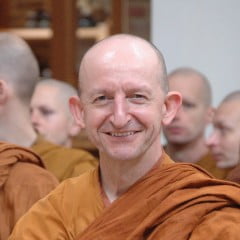
Ajahn Amaro

Born in England in 1956, Ajahn Amaro received his BSc. in Psychology and Physiology from the University of London. Spiritual searching led him to Thailand, where he went to Wat Pah Nanachat,... 閱讀更多

Born in England in 1956, Ajahn Amaro received his BSc. in Psychology and Physiology from the University of London. Spiritual searching led him to Thailand, where he went to Wat Pah Nanachat, a Forest Tradition monastery established for Western disciples of Thai meditation master Ajahn Chah, who ordained him as a bhikkhu in April 1979. He returned to England in October 1979 and joined Ajahn Sumedho at the newly established Chithurst Monastery in West Sussex.

In 1983 he made an 830-mile trek from Chithurst to a new branch monastery, Harnham Vihāra, near the Scottish border. In July 1985, he moved to Amaravati Buddhist Monastery north of London and resided there for many years. In the early 1990s, he started making trips to California every year, eventually establishing Abhayagiri Monastery near Ukiah, Northern California, in June of 1996.

He lived at Abhayagiri until the summer of 2010, holding the position of co-abbot along with Ajahn Pasanno. At that time, he then moved back to Amaravati Buddhist Monastery in England to take up the position of abbot of this large monastic community.

Cover for ความกลัว พ้นหรือจม ?
ความกลัวและกังวลเป็นความรู้สึกที่อยู่กับมนุษย์มานานแสนนาน แต่ละคนล้วนเจอแล้วจาก จากแล้วเจอ เจอแล้วจาก… จากเรื่องนี้ เป็นเรื่องนั้น แล้วไปเรื่องโน้น และอีกหลายๆ เรื่อง ‘เป็น’ ความรู้สึกที่วนอยู่ในใจ และเวียน ‘อยู่’ กับเรื่องราวต่างๆ มากมาย ‘คือ’ วังวนของความทุกข์ และหลุมดำที่ไม่มีใครอยากจะตกลงไป ไม่ว่าคนชาติไหน ภาษาใด ก็เคยพบกับความกลัวและกังวลทั้งสิ้น
這本書是Fear and Fearlessness的翻譯
Cover for Mara and the Mangala II
This story is intended to be a partner to the two novels ‘The Pilgrim Kamanita ~ A Legendary Romance’, written by Karl Gjellerup in 1906, and ‘The Killer ~ Mara and the Mangala, Book I’, written by myself, published in 2019. This present book exists as a tale that both stands on its own and serves as a continuation of the stories in the previous... 閱讀更多

This story is intended to be a partner to the two novels ‘The Pilgrim Kamanita ~ A Legendary Romance’, written by Karl Gjellerup in 1906, and ‘The Killer ~ Mara and the Mangala, Book I’, written by myself, published in 2019.

This present book exists as a tale that both stands on its own and serves as a continuation of the stories in the previous volumes. There is no need to have read the earlier books in order to make sense of this one; however, should the reader wish to go to the source from which many of the characters and scenes of this tale have sprung, the previously published books can be found here and here.

In the tradition of such eminent authors as Charles Dickens, Sir Arthur Conan Doyle and Alexandre Dumas, the present book is being released as a serial novel, one chapter every fortnight, over the years 2025-26. It is planned that, once all the chapters have been released, an edition of the whole story will be published as a single book.

One of the worst things that can happen to a tale to be read for pleasure is to have it surrounded by footnotes and appendices. This is true; but it’s also true that some readers might like to know: ‘Did this come from the Buddha?’ ‘Where can I find the rest of that quote?’ ‘Did that really happen!?’

An appendix of notes and references has therefore been created, which outlines the sources of the derived material that has been used. The main body of the text is not marked in any way to indicate these notes; however, if the reader is curious about a certain passage, they can go to the end of the chapter, look for the page and quotation in question, and see if there’s a comment or reference for it. In this way, if one just wants to read the story and ignore the rest one can easily do so but, if one is interested in finding out more and checking the facts, the origins are mostly outlined there.

Also, gentle reader, please note that the original author (Karl Gjellerup) switched freely between using Sanskrit (the language of the Northern Buddhist and Hindu scriptures) and Pali (the language of the Southern Buddhist scriptures) during the course of his foundational tale. In our efforts to be true to his style this mixture of usage has been maintained in the two subsequent volumes.

Ajahn Amaro
Amaravati Monastery
Spring, 2025

Cover for Happily Ever After. 5 Beyond
Reflections on life goals and priorities. In this volume: - The good, the bad and the unconditioned - ‘We need to talk about Nibbāna’ - Suchness and the square root of minus one - Unshakeable well-being - ... Happily ever after
Cover for Happily Ever After. 4 Money
Reflections on life goals and priorities. In this volume: - Buddhism and the pursuit of wealth - ‘How to live a Dhamma life in the capitalist world of today?’ - A currency of well-being
Cover for Happily Ever After. 2 Emotion
Reflections on life goals and priorities. In this volume: - ‘Heroin or chocolate cake?’ - ‘I am a Buddhist, why am I so angry?’ - The importance of being bored, sad and lonely - ‘If you truly love me, don’t create me in your mind’
Cover for Happily Ever After. 1 Reality
Reflections on life goals and priorities. In this volume: - ‘The Blue Pill or the Red Pill? Why Wake up When my Habits are so Pleasant?’ - ‘Of course it’s happening in your head, Harry, but why on earth should that mean that it is not real?’ - Let the citta draw a picture
Cover for อุเบกขา ธรรมสุดท้าย
อุเบกขายังไม่เป็นเพียงธรรมอันประณีตที่สุด และเป็นธรรมประการสุดท้ายในพรหมวิหาร สี่ – เครื่องอยู่อันประเสริฐของพรหมเท่านั้น แต่ยังเป็นธรรมข้อที่เจ็ดขององค์แห่งการ ตรัสรู้เจ็ดประการ (โพชฌงค์เจ็ด) อีกด้วย เมื่อพระพุทธองค์ได้ตรัสถึงคุณสมบัติของจิตที่ตรัสรู้แล้ว อุเบกขาเป็นคุณสมบัติข้อที่เจ็ดในธรรมเจ็ดประการนั้น และเช่นเดียวกับในบารมีสิบ อุเบกขาก็เป็นธรรมข้อที่สิบในบารมีสิบนั้นเช่นกัน
這本書是Serenity Is the Final Word的翻譯
Cover for Serenity Is the Final Word
"I thought I would begin by offering a few reflections about equanimity or upekkhā. This is one of the most significant psychological, emotional qualities talked about in the Buddhist tradition. However, because we commonly translate the word upekkhā in English as ‘equanimity’, it can easily be overlooked or seen as something a bit insignificant, not so practical or even heartwarming, as the word ‘equanimity’ in... 閱讀更多

"I thought I would begin by offering a few reflections about equanimity or upekkhā. This is one of the most significant psychological, emotional qualities talked about in the Buddhist tradition. However, because we commonly translate the word upekkhā in English as ‘equanimity’, it can easily be overlooked or seen as something a bit insignificant, not so practical or even heartwarming, as the word ‘equanimity’ in English can easily mean ‘indifference’, not really caring – it can be taken to be a switched-off, disconnected and somewhat numb attitude towards things."

Based on a talk given at Amaravati – 26-4-2020

同時可在 ไทย 中取得
Cover for ทางสายกลาง หรือ ทางสายฉัน
เมื่อเราสามารถหาทางสายกลางพบ จะไม่เพียงแค่ได้ผ่อนคลายและสงบสุขเท่านั้น แต่ยังได้ผลลัพธ์ที่ดีอีกด้วย หมายถึงว่าเราสามารถทำงานได้เต็มศักยภาพ เต็มความสามารถ เราสามารถใช้ความคิด จินตนาการ ความถนัดให้เป็นประโยชน์ ต่อการทำงาน ซึ่งเป็นการใช้ความพยายามโดยปราศจากความเครียด
這本書是My Way or The Middle Way的翻譯
Cover for My Way or The Middle Way
The theme for this Dhamma talk is ‘My way or the Middle Way?’ As people might recognize, the title was borrowed from the famous Frank Sinatra song, written by Paul Anka, ‘My Way’, which is the supreme anthem of self-confidence: Through it all, when there was doubt, I ate it up and spit it out. I faced it all and I stood tall, And did... 閱讀更多

The theme for this Dhamma talk is ‘My way or the Middle Way?’ As people might recognize, the title was borrowed from the famous Frank Sinatra song, written by Paul Anka, ‘My Way’, which is the supreme anthem of self-confidence:

Through it all, when there was doubt, I ate it up and spit it out. I faced it all and I stood tall, And did it my way!’

Confidence is definitely a part of the Buddhist path; having faith, having confidence and resolution, these are all aspects of it. But any of us who have spent much time in life trying to follow that voice of self-assurance, of, ‘Even though there is resistance and it is difficult, I’m just going to keep pushing. I will do it my way.’ Or when we are living in a community, or we are in a role of leadership, if we adopt the attitude of, ‘My way or the highway. Either you do it the way I want or you’re on your bike, you are kicked out’ – that leads to stress and difficulty and conflict. Reflecting on this theme, ‘My way or the Middle Way’, there are certainly beneficial aspects to the quality of self-confidence, self-assurance and resolution, but if that is out of balance, if that is wrapped up in self-view and selfcentred thinking, then necessarily the results are going to be painful. You might get what you want but then there might be a lot of wreckage as well, considerable damage created along the way. Probably most of us have had some situations in life where we have come to the conclusion, ‘Well, I got what I wanted, but was it really worth it?’ or ‘I didn’t realize it was going to be like this.’ Or ‘I thought this was going to make me happier. I got what I wanted but ugh!’

In terms of this theme and what would be useful for us to look at, I feel that it is good to consider the way that we work in life – how we relate to doing, to acting, to choosing, how intentions and actions work together. When we use the kind of confidence expressed by Frank Sinatra, ‘I am going to do it my way!’ if we take that approach in life and we act from a place of self-assertion and we just keep pushing – whether this is with our occupation, or working with our family, or working with the rest of the traffic on the road – if we have that kind of contentious attitude, ‘I am going to make this happen,’ since that is wrapped up with self-view, then any kind of work becomes exhausting. Even when we are working with our minds in the meditation hall, thinking, ‘I am going to get jhāna. I am going to make the Breakthrough, it’s Stream Entry or bust!’ This is a guaranteed way to create suffering. Even the work of training our mind to be peaceful can be stressful and exhausting if that work is based on self-view.
同時可在 ไทย 中取得
Cover for Copper Isle Miles
This photo-journal records a pilgrimage made in Sri Lanka in November of 2019. I had been invited numerous times to visit this ancient seedbed of Theravāda Buddhism but, prior to this present occasion, had always declined the offers. Thee reason for this was not a disinterest in the country, with its ancient Buddhist traditions and numerous holy places, rather it was that, if I was... 閱讀更多

This photo-journal records a pilgrimage made in Sri Lanka in November of 2019. I had been invited numerous times to visit this ancient seedbed of Theravāda Buddhism but, prior to this present occasion, had always declined the offers. Thee reason for this was not a disinterest in the country, with its ancient Buddhist traditions and numerous holy places, rather it was that, if I was going to go, I wanted to go quietly as a pilgrim and not on a teaching tour or part of a bustling group of devotees. Sometimes I wondered if I was being too fussy or narrow on this score but, in retrospect, I am very glad to have waited for forty years to make the journey.

Load more