3 ตัวกรอง

Ajahn Sumedho

English, Français

หากต้องการสำรวจสิ่งพิมพ์ของเราในภาษาอื่น ๆ โปรดคลิก "ล้าง" หรือเลือกดูรายการภาษาจากเมนูทางซ้าย

ล้าง

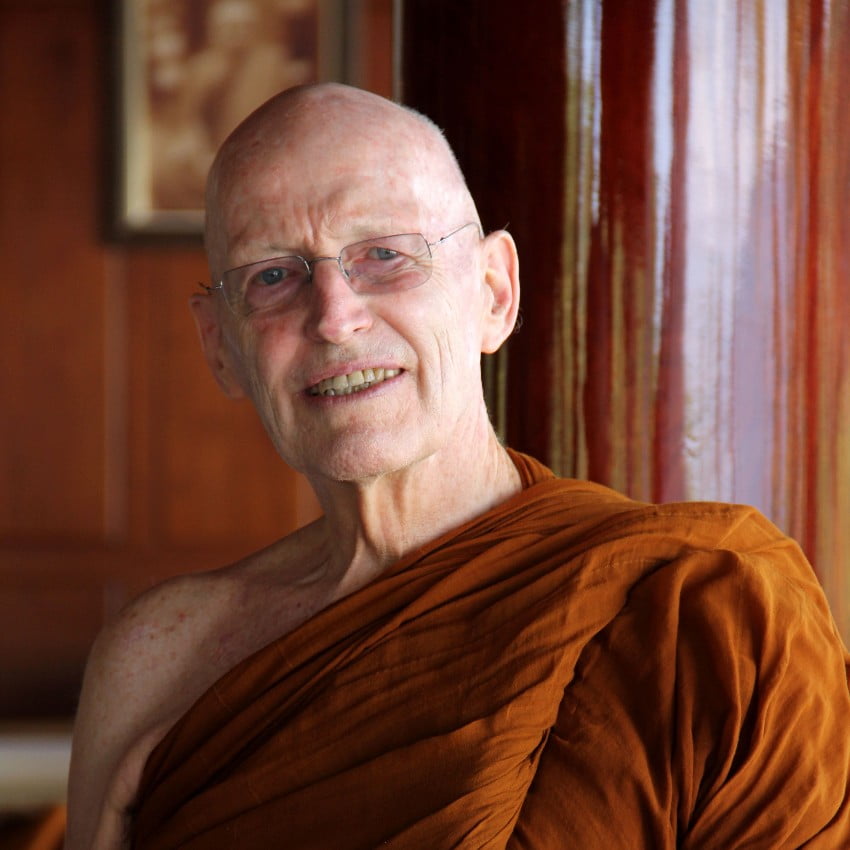
Ajahn Sumedho

Luang Por Sumedho (Ajahn Sumedho) was born in Seattle, Washington in 1934. After serving four years in the US Navy as a medic, he completed a BA in Far Eastern Studies and... อ่านเพิ่มเติม

Luang Por Sumedho (Ajahn Sumedho) was born in Seattle, Washington in 1934. After serving four years in the US Navy as a medic, he completed a BA in Far Eastern Studies and a MA in South Asian Studies.

In 1966, he went to Thailand to practise meditation at Wat Mahathat in Bangkok. Not long afterwards he went forth as a novice monk in a remote part of the country, Nong Khai, and a year of solitary practice followed; he received full admission into the Sangha in 1967.

Although fruitful, the solitary practice showed him the need for a teacher who could more actively guide him. A fortuitous encounter with a visiting monk led him to Ubon province to practise with Venerable Ajahn Chah. He took dependence from Ajahn Chah and remained under his close guidance for ten years. In 1975, Luang Por Sumedho established Wat Pah Nanachat (International Forest Monastery) where Westerners could be trained in English. In 1977, he accompanied Ajahn Chah to England and took up residence at the Hampstead Vihara with three other monks.

Luang Por Sumedho has inducted more than a hundred aspirants of many nationalities into monastic life, and has established four monasteries in England, as well as branch monasteries overseas. In 1979, Luang Por Sumedho established Cittaviveka – Chithurst Buddhist Monastery, in West Sussex, where he served as abbot until 1984. This was the first forest monastery that he established in the West. Here in England he subsequently founded Aruna Ratanagiri Monastery in Harnham, Northumberland, Hartridge Buddhist Monastery in Honiton, Devon and Amaravati Buddhist Monastery in Great Gaddesden, Hertfordshire.

In late 2010, he retired as abbot of Amaravati Buddhist Monastery. From 2010 until early 2021, he lived in Thailand, before returning to live at Amaravati Buddhist Monastery. Luang Por Sumedho continues to share the Dhamma, wherever he resides.

Cover for Les choses telles qu’elles sont
Ajahn Sumedho est un moine de la Tradition de la forêt. Il fut ordonné en Thaïlande, à Nong Khai, en 1967 et s’étant rendu peu après à Wat Pah Pong, il fut le premier disciple occidental d’Ajahn Chah. Après avoir passé une dizaine d’années auprès de son maître, ce dernier lui proposa d’aller en Angleterre à l’invitation de l’English Sangha Trust qui invitait des moines... อ่านเพิ่มเติม

Ajahn Sumedho est un moine de la Tradition de la forêt. Il fut ordonné en Thaïlande, à Nong Khai, en 1967 et s’étant rendu peu après à Wat Pah Pong, il fut le premier disciple occidental d’Ajahn Chah. Après avoir passé une dizaine d’années auprès de son maître, ce dernier lui proposa d’aller en Angleterre à l’invitation de l’English Sangha Trust qui invitait des moines venus d’Asie pour vivre, pratiquer et enseigner le bouddhisme de la tradition Theravada.

Ses enseignements clairs et directs attirèrent rapidement l’attention d’un grand nombre de personnes venues de toutes parts, et en 1979 fut créé Chithurst, le premier monastère de la Tradition de la forêt en occident.

Ce livre est un des premiers recueils d’enseignements qu’Ajahn Sumedho donna à la communauté de moines et de nonnes ainsi qu’aux résidents laïcs au cours de plusieurs retraites d’hiver entre 1979 et 1989. Il offre au lecteur un vaste éventail des aspects les plus importants du Bouddhisme et, par son approche approfondie de la pratique, il nous transmet une vision limpide du chemin du Dhamma. [...]

หนังสือเล่มนี้แปลจาก The way it is
Cover for Les Quatres Nobles Vérités
Ce livret a été élaboré et édité à partir de discours donnés par le Vénérable Ajahn Sumedho à propos de l’enseignement central du Bouddha, à savoir que la souffrance de l’humanité peut être vaincue à l’aide de moyens spirituels. L’enseignement est transmis à travers les Quatre Nobles Vérités du Bouddha, exposées pour la première fois en 528 avant J.C. dans le Parc aux Cerfs à... อ่านเพิ่มเติม

Ce livret a été élaboré et édité à partir de discours donnés par le Vénérable Ajahn Sumedho à propos de l’enseignement central du Bouddha, à savoir que la souffrance de l’humanité peut être vaincue à l’aide de moyens spirituels. L’enseignement est transmis à travers les Quatre Nobles Vérités du Bouddha, exposées pour la première fois en 528 avant J.C. dans le Parc aux Cerfs à Sarnath, près de Varanasi, et a perduré depuis dans le monde Bouddhiste.

หนังสือเล่มนี้แปลจาก The Four Noble Truths (Illustrated Edition)
Cover for The Four Noble Truths (Illustrated Edition)
A small booklet of edited talks given by Ajahn Sumedho on the central teaching of the Buddha: that the unhappiness of humanity can be overcome through spiritual means. This new edition contains illustrations by Ajahn Sucitto.
มีให้บริการใน Català, Deutsch, Español, Français, हिन्दी, Lietuvių kalba, Latviešu, Nederlands, Português, Pусский, සිංහල ด้วย
Cover for Gratitude
Cover for Gratitude

Gratitude

Ajahn Sumedho (2020)
When I reflect on my life as a Buddhist monk, I found one of the most significant turning points was when I started experiencing gratitude (kataññū-katavedī). Gratitude arises spontaneously when one reflects on one’s parents, who made it possible for one to exist as a human being, Luang Por Chah, the teacher, whose wisdom was always directly pointing to the way out of suffering, and... อ่านเพิ่มเติม

When I reflect on my life as a Buddhist monk, I found one of the most significant turning points was when I started experiencing gratitude (kataññū-katavedī). Gratitude arises spontaneously when one reflects on one’s parents, who made it possible for one to exist as a human being, Luang Por Chah, the teacher, whose wisdom was always directly pointing to the way out of suffering, and the Lord Buddha’s teaching giving direction for one’s life.

Cover for La Conscience Intuitive
Ce livre est un recueil d’enseignements donnés par Ajahn Sumedho lors de différentes retraites (plus particulièrement en 2001) dont les principaux participants étaient des moines et des nonnes. Ces exposés témoignent d’une conscience intuitive de l’enseignement du Bouddha, fruit de plus de trente-cinq années de pratique en tant que moine bouddhiste.
หนังสือเล่มนี้แปลจาก Intuitive Awareness
Cover for Intuitive Awareness
This book is compiled from talks given mostly in 2001 by Ajahn Sumedho. The first edition was originally published in 2004, but has long since been out of print. This new edition has been reviewed for typographical errors and redesigned, and some re- editing has been done. However, the Dhamma content has not been changed. The talks were transcribed, edited and proofread by various members... อ่านเพิ่มเติม

This book is compiled from talks given mostly in 2001 by Ajahn Sumedho. The first edition was originally published in 2004, but has long since been out of print. This new edition has been reviewed for typographical errors and redesigned, and some re- editing has been done. However, the Dhamma content has not been changed. The talks were transcribed, edited and proofread by various members of the sangha as well as people from the broader community, and a variety of people helped with the creation of the front cover. The editors wish to express their deep gratitude for all of the generous and kind-hearted effort put into making these teachings available in book format.

มีให้บริการใน Français, Nederlands, සිංහල ด้วย
Cover for Anthology Vol 5 – The Wheel of Truth
The title of this book refers to the image of the Buddha’s teaching, the Wheel of Truth (or Dhamma). It is a wheel that he set rolling in his first discourse by proclaiming the Four Noble Truths and the Eightfold Path of practice. This teaching remains as the axis of Ajahn Sumedho’s teaching and personal contemplative work. This particular collection of his Dhamma talks and... อ่านเพิ่มเติม

The title of this book refers to the image of the Buddha’s teaching, the Wheel of Truth (or Dhamma). It is a wheel that he set rolling in his first discourse by proclaiming the Four Noble Truths and the Eightfold Path of practice. This teaching remains as the axis of Ajahn Sumedho’s teaching and personal contemplative work. This particular collection of his Dhamma talks and dialogues is composed of material that has appeared in various newsletters and magazines before; it derives from different periods in Ajahn Sumedho’s teaching career, but it has been gathered into three parts to address overarching themes.

มีให้บริการใน Deutsch ด้วย
Cover for Mindfulness – The Path to the Deathless
The aim of this book is to provide instruction and reflection on Buddhist meditation as taught by Ajahn Sumedho, using material extracted from talks he gave in the early 1980s. These talks were almost all given to monastics who were familiar with the language and terms of Theravada Buddhism – but Ajahn Sumedho’s approach is not technically intricate, and so we felt that many more... อ่านเพิ่มเติม

The aim of this book is to provide instruction and reflection on Buddhist meditation as taught by Ajahn Sumedho, using material extracted from talks he gave in the early 1980s. These talks were almost all given to monastics who were familiar with the language and terms of Theravada Buddhism – but Ajahn Sumedho’s approach is not technically intricate, and so we felt that many more people could benefit from these instructions than the small gatherings in the monasteries. You are therefore invited to make use this book for your own spiritual practice.

มีให้บริการใน Pусский ด้วย
Cover for Cittaviveka

Cittaviveka

Ajahn Sumedho (2011)
‘CITTAVIVEKA’, the title of this book, is a word in the Pali language meaning ‘the mind of non-attachment’. A major theme of the Buddha’s teaching – known as the Dhamma – is that suffering is caused by attachment, and that the aim and result of the correct application of the teachings is a mind of non-attachment.
มีให้บริการใน Magyar, Pусский ด้วย
Load more