3 filtre

Ajahn Amaro

Deutsch, English

Pentru a explora publicațiile noastre în alte limbi, faceți clic pe „Șterge” sau răsfoiți lista de limbi din meniul din stânga.

Șterge

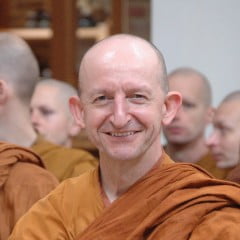
Ajahn Amaro

Born in England in 1956, Ajahn Amaro received his BSc. in Psychology and Physiology from the University of London. Spiritual searching led him to Thailand, where he went to Wat Pah Nanachat,... Citește mai mult

Born in England in 1956, Ajahn Amaro received his BSc. in Psychology and Physiology from the University of London. Spiritual searching led him to Thailand, where he went to Wat Pah Nanachat, a Forest Tradition monastery established for Western disciples of Thai meditation master Ajahn Chah, who ordained him as a bhikkhu in April 1979. He returned to England in October 1979 and joined Ajahn Sumedho at the newly established Chithurst Monastery in West Sussex.

In 1983 he made an 830-mile trek from Chithurst to a new branch monastery, Harnham Vihāra, near the Scottish border. In July 1985, he moved to Amaravati Buddhist Monastery north of London and resided there for many years. In the early 1990s, he started making trips to California every year, eventually establishing Abhayagiri Monastery near Ukiah, Northern California, in June of 1996.

He lived at Abhayagiri until the summer of 2010, holding the position of co-abbot along with Ajahn Pasanno. At that time, he then moved back to Amaravati Buddhist Monastery in England to take up the position of abbot of this large monastic community.

Cover for Mara and the Mangala II
This story is intended to be a partner to the two novels ‘The Pilgrim Kamanita ~ A Legendary Romance’, written by Karl Gjellerup in 1906, and ‘The Killer ~ Mara and the Mangala, Book I’, written by myself, published in 2019. This present book exists as a tale that both stands on its own and serves as a continuation of the stories in the previous... Citește mai mult

This story is intended to be a partner to the two novels ‘The Pilgrim Kamanita ~ A Legendary Romance’, written by Karl Gjellerup in 1906, and ‘The Killer ~ Mara and the Mangala, Book I’, written by myself, published in 2019.

This present book exists as a tale that both stands on its own and serves as a continuation of the stories in the previous volumes. There is no need to have read the earlier books in order to make sense of this one; however, should the reader wish to go to the source from which many of the characters and scenes of this tale have sprung, the previously published books can be found here and here.

In the tradition of such eminent authors as Charles Dickens, Sir Arthur Conan Doyle and Alexandre Dumas, the present book is being released as a serial novel, one chapter every fortnight, over the years 2025-26. It is planned that, once all the chapters have been released, an edition of the whole story will be published as a single book.

One of the worst things that can happen to a tale to be read for pleasure is to have it surrounded by footnotes and appendices. This is true; but it’s also true that some readers might like to know: ‘Did this come from the Buddha?’ ‘Where can I find the rest of that quote?’ ‘Did that really happen!?’

An appendix of notes and references has therefore been created, which outlines the sources of the derived material that has been used. The main body of the text is not marked in any way to indicate these notes; however, if the reader is curious about a certain passage, they can go to the end of the chapter, look for the page and quotation in question, and see if there’s a comment or reference for it. In this way, if one just wants to read the story and ignore the rest one can easily do so but, if one is interested in finding out more and checking the facts, the origins are mostly outlined there.

Also, gentle reader, please note that the original author (Karl Gjellerup) switched freely between using Sanskrit (the language of the Northern Buddhist and Hindu scriptures) and Pali (the language of the Southern Buddhist scriptures) during the course of his foundational tale. In our efforts to be true to his style this mixture of usage has been maintained in the two subsequent volumes.

Ajahn Amaro
Amaravati Monastery
Spring, 2025

Cover for Happily Ever After. 5 Beyond
Reflections on life goals and priorities. In this volume: - The good, the bad and the unconditioned - ‘We need to talk about Nibbāna’ - Suchness and the square root of minus one - Unshakeable well-being - ... Happily ever after
Cover for Happily Ever After. 4 Money
Reflections on life goals and priorities. In this volume: - Buddhism and the pursuit of wealth - ‘How to live a Dhamma life in the capitalist world of today?’ - A currency of well-being
Cover for Happily Ever After. 2 Emotion
Reflections on life goals and priorities. In this volume: - ‘Heroin or chocolate cake?’ - ‘I am a Buddhist, why am I so angry?’ - The importance of being bored, sad and lonely - ‘If you truly love me, don’t create me in your mind’
Cover for Happily Ever After. 1 Reality
Reflections on life goals and priorities. In this volume: - ‘The Blue Pill or the Red Pill? Why Wake up When my Habits are so Pleasant?’ - ‘Of course it’s happening in your head, Harry, but why on earth should that mean that it is not real?’ - Let the citta draw a picture
Cover for Hinein-Hören
Es gibt eine Anzahl von Themen die Menschen, welche buddhistische Meditation praktizieren, sehr geläufig sind: „Atemachtsamkeit“, bei der man sich auf den Rhythmus des Atems fokussiert; „Gehmeditation“, die sich um das Spüren der Schritte dreht, während man einen Pfad auf- und abgeht; das innerliche Wiederholen eines Mantras, wie etwa „Bud-dho“ – diese sind alle dazu bestimmt zu helfen, die Aufmerksamkeit in der Gegenwart genau diesen... Citește mai mult

Es gibt eine Anzahl von Themen die Menschen, welche buddhistische Meditation praktizieren, sehr geläufig sind: „Atemachtsamkeit“, bei der man sich auf den Rhythmus des Atems fokussiert; „Gehmeditation“, die sich um das Spüren der Schritte dreht, während man einen Pfad auf- und abgeht; das innerliche Wiederholen eines Mantras, wie etwa „Bud-dho“ – diese sind alle dazu bestimmt zu helfen, die Aufmerksamkeit in der Gegenwart genau diesen Moments, dieser gegenwärtigen Realität zu verankern.

Neben diesen bekannteren Methoden gibt es viele andere, welche in ähnlicher Funktion dienlich sein können. Eine von diesen ist bekannt als „Hinein-Hören“ oder „Meditation über den inneren Ton“ oder in Sanskrit „Nada-Yoga“. Diese Begriffe beziehen sich alle auf das Hören von dem, was „der Klang der Stille“ oder „der Nada-Ton“ genannt wird. „Nada“ ist das Sanskritwort für „Klang“, ebenso wie das spanische Wort für „nichts“ – ein interessanter und bedeutungsvoller Zufall.

Această carte este o traducere a Inner Listening
Cover for Auf den Geist kommt’s an
Der Titel dieses Buchs, Auf den Geist kommt’s an, lenkt die Aufmerksamkeit zur geistigen Einstellung. Er weist darauf hin, wie enorm wichtig unsere Haltung ist, wenn der Geist Erfahrungen aufnimmt und verarbeitet, und er deutet auf jenen Aspekt der Dhamma-Praxis, alles zu unserem Lehrer zu machen. An unserem offenen Retreat 2017 im Amaravati-Kloster nahmen über 400 Menschen teil. Ajahn Sumedho hielt jeden Abend einen Vortrag... Citește mai mult

Der Titel dieses Buchs, Auf den Geist kommt’s an, lenkt die Aufmerksamkeit zur geistigen Einstellung. Er weist darauf hin, wie enorm wichtig unsere Haltung ist, wenn der Geist Erfahrungen aufnimmt und verarbeitet, und er deutet auf jenen Aspekt der Dhamma-Praxis, alles zu unserem Lehrer zu machen. An unserem offenen Retreat 2017 im Amaravati-Kloster nahmen über 400 Menschen teil. Ajahn Sumedho hielt jeden Abend einen Vortrag und andere Gast-Ajahns boten täglich Anleitungen an und führten Frage-und-Antwort Sitzungen durch. Für einige von uns war dies eine sehr inspirierende Zeit. Es gab eine Vielzahl erhellender und einfallsreicher Vorträge; für mich war es wahrhaft eine ermutigende und schöne Veranstaltung. Aber was, wenn die Einstellung anderer unterschiedlich dazu war? Selbst wenn sie inspirierende Vorträge hörten, könnten sie angefangen haben zu denken, dass es zu wenige waren. Oder sie könnten die Lehrer miteinander verglichen haben, um zu beurteilen, wer besser war. Sogar so etwas Edles, Schönes und Heilsames, wie das Hören eines Dhamma-Vortrags, hätte zu einem Grund für Leiden, Enttäuschung oder Unzufriedenheit werden können, wenn die Person das Erlebnis in einer ungeschickten Art aufgefasst hätte. Unser Geist kann sich leicht in Urteilen verfangen: „Dies“ ist nicht so gut wie „das“ oder „jetzt“ ist nicht ganz so real oder gut wie „diese Aussicht dann in der Zukunft“ oder „jene tolle Zeit damals in der Vergangenheit“. Wenn unser Geist dies tut, können wir es betrachten. Dieses Gefühl der Enttäuschung, dieser vergleichende Geist, kann in diesem Moment zu unserem Lehrer werden. Wenn wir weise sind, wird alles uns belehren: das Wetter, unsere Erinnerungen, unsere physische Verfassung, die Umgebung und die Menschen um uns herum.

Această carte este o traducere a Mind Is What Matters: the Phenomenological Approach of the Buddha
Cover for Serenity Is the Final Word
"I thought I would begin by offering a few reflections about equanimity or upekkhā. This is one of the most significant psychological, emotional qualities talked about in the Buddhist tradition. However, because we commonly translate the word upekkhā in English as ‘equanimity’, it can easily be overlooked or seen as something a bit insignificant, not so practical or even heartwarming, as the word ‘equanimity’ in... Citește mai mult

"I thought I would begin by offering a few reflections about equanimity or upekkhā. This is one of the most significant psychological, emotional qualities talked about in the Buddhist tradition. However, because we commonly translate the word upekkhā in English as ‘equanimity’, it can easily be overlooked or seen as something a bit insignificant, not so practical or even heartwarming, as the word ‘equanimity’ in English can easily mean ‘indifference’, not really caring – it can be taken to be a switched-off, disconnected and somewhat numb attitude towards things."

Based on a talk given at Amaravati – 26-4-2020

De asemenea disponibil în ไทย
Cover for Die Insel
NIBBĀNA (Nirvāna in Sanskrit) ist ein Wort, das verwendet wird, um eine Erfahrung zu beschreiben. Wenn das Herz frei von allen Verdunkelungen ist und sich in völliger Übereinstimmung mit der Natur, der letztendlichen Realität (Dhamma) befindet, erfährt es perfekten Frieden, Freude und Zufriedenheit. Diese Qualitäten werden durch das Wort Nibbāna ausgedrückt. Der Zweck dieses Buches ist es, die speziellen Lehren des Buddhas zu umreißen, die... Citește mai mult

NIBBĀNA (Nirvāna in Sanskrit) ist ein Wort, das verwendet wird, um eine Erfahrung zu beschreiben. Wenn das Herz frei von allen Verdunkelungen ist und sich in völliger Übereinstimmung mit der Natur, der letztendlichen Realität (Dhamma) befindet, erfährt es perfekten Frieden, Freude und Zufriedenheit. Diese Qualitäten werden durch das Wort Nibbāna ausgedrückt. Der Zweck dieses Buches ist es, die speziellen Lehren des Buddhas zu umreißen, die auf Möglichkeiten hinweisen und diese erläutern, wie jene Qualitäten verwirklicht werden können. Aus buddhistischer Sicht ist die Verwirklichung von Nibbāna die Erfüllung des höchsten menschlichen Potenzials - ein Potenzial, das in jedem von uns vorhanden ist, unabhängig von Nationalität oder Glaubensbekenntnis.

Bei der Betrachtung buddhistischer Begriffe und der vielen möglichen Ausdrucksweisen die in dieser Anthologie zu finden sind, ist es wichtig, ein paar Dinge im Auge zu behalten. Erstens ist es ein Merkmal der Lehre des Buddhas, insbesondere in den Theravāda Schriften, dass die Wahrheit und der dahin führende Weg oft dadurch aufgezeigt werden, indem man beschreibt, was sie nicht sind anstatt was sie sind.

Diese Ausdrucksweise hat eine ungefähre Entsprechung in der klassischen indischen Philosophie der Upanischaden, im bekannten Prinzip von „neti ... neti“, was „nicht dies ... nicht dies“ bedeutet. Mit diesem Ausdruck wird die Realität der Erscheinungen zurückgewiesen. In der christlich-theologischen Sprache wird dieser Ansatz, der Dinge definiert durch das was sie nicht sind, als apophatische Methode bezeichnet - auch bekannt als via negativa, und sie wurde von einer Reihe bedeutender Christen im Laufe der Jahrhunderte angewandt

Această carte este o traducere a The Island
Cover for My Way or The Middle Way
The theme for this Dhamma talk is ‘My way or the Middle Way?’ As people might recognize, the title was borrowed from the famous Frank Sinatra song, written by Paul Anka, ‘My Way’, which is the supreme anthem of self-confidence: Through it all, when there was doubt, I ate it up and spit it out. I faced it all and I stood tall, And did... Citește mai mult

The theme for this Dhamma talk is ‘My way or the Middle Way?’ As people might recognize, the title was borrowed from the famous Frank Sinatra song, written by Paul Anka, ‘My Way’, which is the supreme anthem of self-confidence:

Through it all, when there was doubt, I ate it up and spit it out. I faced it all and I stood tall, And did it my way!’

Confidence is definitely a part of the Buddhist path; having faith, having confidence and resolution, these are all aspects of it. But any of us who have spent much time in life trying to follow that voice of self-assurance, of, ‘Even though there is resistance and it is difficult, I’m just going to keep pushing. I will do it my way.’ Or when we are living in a community, or we are in a role of leadership, if we adopt the attitude of, ‘My way or the highway. Either you do it the way I want or you’re on your bike, you are kicked out’ – that leads to stress and difficulty and conflict. Reflecting on this theme, ‘My way or the Middle Way’, there are certainly beneficial aspects to the quality of self-confidence, self-assurance and resolution, but if that is out of balance, if that is wrapped up in self-view and selfcentred thinking, then necessarily the results are going to be painful. You might get what you want but then there might be a lot of wreckage as well, considerable damage created along the way. Probably most of us have had some situations in life where we have come to the conclusion, ‘Well, I got what I wanted, but was it really worth it?’ or ‘I didn’t realize it was going to be like this.’ Or ‘I thought this was going to make me happier. I got what I wanted but ugh!’

In terms of this theme and what would be useful for us to look at, I feel that it is good to consider the way that we work in life – how we relate to doing, to acting, to choosing, how intentions and actions work together. When we use the kind of confidence expressed by Frank Sinatra, ‘I am going to do it my way!’ if we take that approach in life and we act from a place of self-assertion and we just keep pushing – whether this is with our occupation, or working with our family, or working with the rest of the traffic on the road – if we have that kind of contentious attitude, ‘I am going to make this happen,’ since that is wrapped up with self-view, then any kind of work becomes exhausting. Even when we are working with our minds in the meditation hall, thinking, ‘I am going to get jhāna. I am going to make the Breakthrough, it’s Stream Entry or bust!’ This is a guaranteed way to create suffering. Even the work of training our mind to be peaceful can be stressful and exhausting if that work is based on self-view.
De asemenea disponibil în ไทย
Cover for Copper Isle Miles
This photo-journal records a pilgrimage made in Sri Lanka in November of 2019. I had been invited numerous times to visit this ancient seedbed of Theravāda Buddhism but, prior to this present occasion, had always declined the offers. Thee reason for this was not a disinterest in the country, with its ancient Buddhist traditions and numerous holy places, rather it was that, if I was... Citește mai mult

This photo-journal records a pilgrimage made in Sri Lanka in November of 2019. I had been invited numerous times to visit this ancient seedbed of Theravāda Buddhism but, prior to this present occasion, had always declined the offers. Thee reason for this was not a disinterest in the country, with its ancient Buddhist traditions and numerous holy places, rather it was that, if I was going to go, I wanted to go quietly as a pilgrim and not on a teaching tour or part of a bustling group of devotees. Sometimes I wondered if I was being too fussy or narrow on this score but, in retrospect, I am very glad to have waited for forty years to make the journey.

Cover for Catastrophe/Apostrophe: The Buddha’s Teachings on Dependent Origination/Cessation
Over the last few years I have led residential retreats specifically on the theme of dependent origination on at least five occasions – at Amaravati in the U.K., in Mae Rim, Thailand, and with Le Refuge, at Monastère de Ségriès, in the south of France. Various aspects of this rich, essential theme of Buddhist teaching have been focused upon in these different situations, according to... Citește mai mult

Over the last few years I have led residential retreats specifically on the theme of dependent origination on at least five occasions – at Amaravati in the U.K., in Mae Rim, Thailand, and with Le Refuge, at Monastère de Ségriès, in the south of France. Various aspects of this rich, essential theme of Buddhist teaching have been focused upon in these different situations, according to the interests and needs of the various communities. The booklet entitled ‘Just One More…’ – Appreciative Joy: Jealousy, Selfish Desire and the Buddha’s Teaching on the Cycles of Addiction was based on the material from one of these events, a ten-day retreat held at Amaravati in July 2013. Most of the material gathered in this present book was presented at a retreat in Provence, in April 2018; the remainder is from the Mae Rim retreats of 2016-18.

The subject of dependent origination is intrinsically rich and varied, subtle and multi-dimensional, as the Buddha expressed in this notable exchange with his disciple and attendant Ven. Ānanda:

Thus have I heard. On one occasion the Blessed One was living among the Kurus, near a town of theirs named Kammāsadhamma. There Ven. Ānanda approached the Blessed One and, on arrival, having bowed down to the Blessed One, sat to one side. As he was sitting there he said to the Blessed One: ‘It’s wonderful, venerable sir, it’s marvellous, how profound this dependent origination is, and how profound its appearance, and yet to me it appears as clear as clear can be.’ ‘Do not say that, Ānanda! Do not say that! This dependent origination is profound and it appears profound. It is through not understanding and not penetrating this Dhamma that this generation has become like a tangled ball of string, matted like a bird’s nest, tangled like coarse grass and is unable to pass beyond the cycles of rebirth, beyond the planes of deprivation, woe and bad destinations.’ (D 15.1)

There have already been many erudite and wise explorations of the subject published in English, such as Dependent Origination – The Buddha’s Law of Conditionality by Ven. P.A. Payutto; the collection of five chapters on the theme in Ajahn Sumedho’s book The Way It Is; Ajahn Buddhadāsa’s book Under the Bodhi Tree: Buddha’s Original Vision of Dependent Co-arising, as well as many others. The intention of this present volume, whilst acknowledging the already great storehouse of perspectives available, is to focus upon practical means of understanding and applying the principles of dependent origination in order to support the freeing of the heart from addictive and destructive cycles of attitude and behaviour. In particular the emphasis will be on the exit points from this ‘Wheel of Becoming’ (bhavacakka) this cyclical process where the mind feels itself to be imprisoned in a habitual round of promise, gratification and disappointment.

De asemenea disponibil în Français
Load more