2 filtri

Ajahn Amaro

English

Per esplorare le nostre pubblicazioni in altre lingue, fai clic su "Cancella" o sfoglia l'elenco delle lingue nel menu a sinistra.

Cancella

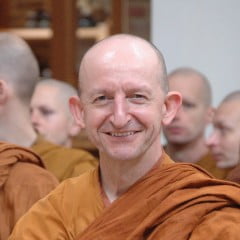
Ajahn Amaro

Born in England in 1956, Ajahn Amaro received his BSc. in Psychology and Physiology from the University of London. Spiritual searching led him to Thailand, where he went to Wat Pah Nanachat,... Leggi di più

Born in England in 1956, Ajahn Amaro received his BSc. in Psychology and Physiology from the University of London. Spiritual searching led him to Thailand, where he went to Wat Pah Nanachat, a Forest Tradition monastery established for Western disciples of Thai meditation master Ajahn Chah, who ordained him as a bhikkhu in April 1979. He returned to England in October 1979 and joined Ajahn Sumedho at the newly established Chithurst Monastery in West Sussex.

In 1983 he made an 830-mile trek from Chithurst to a new branch monastery, Harnham Vihāra, near the Scottish border. In July 1985, he moved to Amaravati Buddhist Monastery north of London and resided there for many years. In the early 1990s, he started making trips to California every year, eventually establishing Abhayagiri Monastery near Ukiah, Northern California, in June of 1996.

He lived at Abhayagiri until the summer of 2010, holding the position of co-abbot along with Ajahn Pasanno. At that time, he then moved back to Amaravati Buddhist Monastery in England to take up the position of abbot of this large monastic community.

Cover for For the Love of the World
Almost daily the media tell us that this is a time of environmental crisis. In 2012 the northern polar ice cap melted more than ever before in human memory. Species are said to be disappearing faster than at any time since the last mass extinction, 70 million years ago. Extreme storms and floods are becoming more common events, and 2012 was one of the ten... Leggi di più

Almost daily the media tell us that this is a time of environmental crisis. In 2012 the northern polar ice cap melted more than ever before in human memory. Species are said to be disappearing faster than at any time since the last mass extinction, 70 million years ago. Extreme storms and floods are becoming more common events, and 2012 was one of the ten warmest globally since record-keeping began 160 years ago. It does indeed seem to be a time of crisis.

When we consider the fragile and fleeting biosphere that we live in, these changes we are seeing and experiencing all around us can easily lead us to fear: What is going to happen? Will my home be destroyed by flood or fire? Will the droughts lead to food shortages? Will all the birds and fishes die? Will our children and grandchildren – and we humans – survive? And is there anything I can do in response to this crisis that will truly make a difference?

One phenomenon that does not get a lot of attention is that things have a tendency to create their opposites: times of war can give rise to occasions of unparalleled kindness […]

Cover for Inner Listening
There are a number of themes that are very familiar to people who practise Buddhist meditation: ‘mindfulness of breathing’, where you focus on the rhythm of the breath; ‘walking meditation’, that revolves around the feeling of the footsteps as you walk up and down a path; the internal repetition of a mantra, such as ‘Bud-dho’ – these are all designed to help ground the attention... Leggi di più

There are a number of themes that are very familiar to people who practise Buddhist meditation: ‘mindfulness of breathing’, where you focus on the rhythm of the breath; ‘walking meditation’, that revolves around the feeling of the footsteps as you walk up and down a path; the internal repetition of a mantra, such as ‘Bud-dho’ – these are all designed to help ground the attention in the presence of this very moment, this present reality.

Along with these more well-known methods there are many others that can serve a similar function. One of these is known as ‘inner listening’ or ‘meditation on the inner sound’ or, in Sanskrit, ‘nada yoga’. These terms all refer to attending to what has been called ‘the sound of silence’, or ‘the nada-sound’. ‘Nada’ is the Sanskrit word for ‘sound’ as well as being the Spanish word for ‘nothing’ – an interesting and accidentally meaningful coincidence.

Disponibile anche in Deutsch, Español, Français, italiano, සිංහල
Cover for Rain on the Nile
When Silent Rain was first compiled, back in 1993, part of the idea of producing such a varied collection of material – talks, poems, travelogues and artwork – was that it would then provide an easy source for smaller offprints over the years. Things, however, rarely turn out as predicted by foresight and thus, up until now, no smaller booklets had been spawned from it.... Leggi di più

When Silent Rain was first compiled, back in 1993, part of the idea of producing such a varied collection of material – talks, poems, travelogues and artwork – was that it would then provide an easy source for smaller offprints over the years. Things, however, rarely turn out as predicted by foresight and thus, up until now, no smaller booklets had been spawned from it.

This present book, Rain on the Nile, is something of a remedy for that, being both an outcome of that original intention as well as an arena for the offering up of some more recent material – to wit, the travelogue of a journey to Egypt made in December of 2006. In truth, without there having been plans to reprint some of the talks from Silent Rain, the Egyptian diary would never have been written.

The idea to select some talks from the book and to create this smaller reprint was originally that of Venerable Tenzin Chogkyi, an American nun practicing in the Tibetan tradition. She had been the recipient of a bequest from a family member and was of a mind to direct some of it to be used to bring parts of Silent Rain back into circulation, the original stock of books having long ago been exhausted. She had found the book very helpful in her own life and wished it to be accessible to others. She thus approached me, in the autumn of 2006, and floated the idea of such an offprint being sponsored by her. I readily agreed and, during the conversation, it was mentioned that I had plans to travel to Egypt with Luang Por Sumedho that December.

Disponibile anche in Español
Cover for Tudong, The Long Road North
Tudong is a Thai derivative of the Pali word dhutanga translating literally as ‘means of shaking off’; it is used to refer to the austere or ascetic practices allowed by the Buddha for his disciples. These practices are thirteen in number and include, for example: eating only one meal a day, eating all your food together in your alms-bowl, never lying down, only wearing robes... Leggi di più

Tudong is a Thai derivative of the Pali word dhutanga translating literally as ‘means of shaking off’; it is used to refer to the austere or ascetic practices allowed by the Buddha for his disciples. These practices are thirteen in number and include, for example: eating only one meal a day, eating all your food together in your alms-bowl, never lying down, only wearing robes made from scraps of thrown-away cloth, taking the shade of a tree as your only shelter. These practices are seen as a ‘means of shaking off’ since austerity of lifestyle, when rightly applied, can be greatly conducive to the development of wisdom and insight – that is, the shaking off of one’s delusions.

The word tudong is also used to refer to those monks who adhere closely to the monastic discipline and whose practice of the Buddha’s teachings is based on meditation and the cultivation of these dhutangas. Both the monastic discipline and the additional constraints of the dhutanga practices are tools used to help contain the mind. This containment is achieved as they prevent or make clear the tendencies of the mind to ‘flow out’; that is, absorb into the likes […]”

Cover for Rugged Interdependency
Perhaps it is impossible to say where anything really begins, nevertheless, it can be useful to map out a few landmarks here and there. Accordingly, here is a little of the background against and amongst which much of the thread of these travelogues unravels. In the early 1980s Ajahn Sumedho began to make regular visits to northern California. He was the senior Western disciple of... Leggi di più

Perhaps it is impossible to say where anything really begins, nevertheless, it can be useful to map out a few landmarks here and there. Accordingly, here is a little of the background against and amongst which much of the thread of these travelogues unravels.

In the early 1980s Ajahn Sumedho began to make regular visits to northern California. He was the senior Western disciple of Ajahn Chah, one of the most highly respected Buddhist masters of the Thai forest tradition of Theravāda Buddhism, and he had been invited to come and teach in the US by Jack Kornfield, a former Peace Corps volunteer and psychologist, with whom he had spent some time in Thailand, in the late ’60s, when they were both monks under Ajahn Chah’s tutelage.

Jack had left the monk’s robes after returning to the States in the early ’70s and, with his friends Sharon Salzberg, Joseph Goldstein and Jacqueline Schwarz (now Mandell), had embarked upon establishing the Buddhist retreat center in Massachusetts called Insight Meditation Society (IMS). This had met with great success but had also revealed some differences in styles of teaching and practice amongst the founders. These differences, along with the massive interest in Buddhist meditation that was brewing in northern California, led Jack back to his city of origin, San Francisco, to found a parallel center to IMS on the West Coast. When it eventually came into being the new place became known as Spirit Rock Meditation Center.

These annual invitations to California were doubly attractive to Ajahn Sumedho in that, not only being an American and an alumnus of Berkeley University and thus being given a chance to visit his old stomping grounds, they also gave him the opportunity to visit his elderly parents and sister in San Diego. It therefore duly became part of his annual schedule to step out of the many duties he had in the foundation of his new monasteries in England (Cittaviveka in West Sussex and Amaravati in Hertfordshire) and to head to the West Coast for a few weeks to teach and to see family.

Over the next ten years he developed a devoted following of students in the San Francisco Bay Area. In 1988 they formed the Sanghapala Foundation, with the mission of creating a branch Monastery of Ajahn Chah’s lineage somewhere in northern California. Dr. Marc Lieberman, Nancy Garfield, Debbie Stamp and […]”

Cover for An Introduction to the Life and Teachings of Ajahn Chah
One evening in Northeast Thailand… Night is falling swiftly. The forest reverberates with the undulating buzz of countless crickets and the eerie rising wail of tropical cicadas. A few stars poke dimly through the treetops. Amid the gathering darkness there is a pool of warm light, thrown from a pair of kerosene lanterns illuminating the open area below a hut raised up on stilts. Beneath... Leggi di più

One evening in Northeast Thailand…

Night is falling swiftly. The forest reverberates with the undulating buzz of countless crickets and the eerie rising wail of tropical cicadas. A few stars poke dimly through the treetops. Amid the gathering darkness there is a pool of warm light, thrown from a pair of kerosene lanterns illuminating the open area below a hut raised up on stilts. Beneath their glow, a couple of dozen people are gathered around a small, solidly-built monk who is seated cross-legged on a wicker bench. The air is filled with a vibrant peace. Venerable Ajahn Chah is teaching.

In some ways the group gathered here is a motley crew. Close beside Ajahn Chah (or Luang Por, Venerable Father, as he is affectionately known to his students) is a cluster of bhikkhus (monks) and novices; most of them are Thai or Lao, but there are a few pale-skinned figures among them – a Canadian, two Americans, a young Australian and an Englishman. In front of the Ajahn sits a well-groomed middle-aged couple, he in a stiff suit and she coiffed and gold-bedecked – he’s a member of parliament from a distant province, they’re taking […]

Disponibile anche in italiano
Cover for Silent Rain
In the way of spiritual life, creation tends to happen through response to circumstances rather than from any self-propelled initiative. In the summer of 1993, whilst I was doing some teaching in Detroit for a few days, I was asked if I had ever written a book. I replied, “Yes, but it’s long out of print.” “Could it be reprinted?” came the inquiry. “Theoretically yes,... Leggi di più

In the way of spiritual life, creation tends to happen through response to circumstances rather than from any self-propelled initiative.

In the summer of 1993, whilst I was doing some teaching in Detroit for a few days, I was asked if I had ever written a book. I replied, “Yes, but it’s long out of print.” “Could it be reprinted?” came the inquiry. “Theoretically yes, of course….”

Before I knew it donations for such a reprint started to be offered in quantity. The book in question, by the way, was Tudong – The Long Road North, which I had written in 1984 following a long walk that I had made through England. We had only printed a thousand copies at the time and they were long gone by now.

When I mentioned to some other supporters in San Francisco a few days later that reprinting Tudong was in the air, they suggested: “Why not put together a collection of more recent stuff instead?” “Good idea,” I thought. “That makes sense ….” On returning to England I talked the possibility over with Ajahn Sucitto – the monk who looks after all our publications – who responded by saying, “Great. You could include some of those travelogues, and maybe some poems of yours ….” It thus gathered momentum and its own life began to unfold.

As the text selected itself and grew I began to think of illustrations that might he used to round out the book. There were a number that had already been produced for various Sangha publications, and ones that I had drawn over the years for members of my family. I gathered these together and found a few that seemed to match the different moods and themes of the book.

“What you are now holding in your hands therefore is the confluence of all these elements. More than anything else it is a scrapbook – a simple cross-section through the world of someone who, in this late 20th Century time, has chosen to live as a Buddhist monk. In putting this book together, every effort has been made to render it as accessible as possible. If, however, at some point its meaning or reason escapes you, hopefully the music will tide you over.

Amaro Bhikkhu Troy November 1994”
Cover for The Island
A difficulty with the word ‘nibbāna’ is that its meaning is beyond the power of words to describe. It is, essentially, undefinable. Another difficulty is that many Buddhists see Nibbāna as something unobtainable – as so high and so remote that we’re not worthy enough to try for it. Or we see Nibbāna as a goal, as an unknown, undefined something that we should somehow... Leggi di più

A difficulty with the word ‘nibbāna’ is that its meaning is beyond the power of words to describe. It is, essentially, undefinable.

Another difficulty is that many Buddhists see Nibbāna as something unobtainable – as so high and so remote that we’re not worthy enough to try for it. Or we see Nibbāna as a goal, as an unknown, undefined something that we should somehow try to attain.

Most of us are conditioned in this way. We want to achieve or attain something that we don’t have now. So Nibbāna is looked at as something that, if you work hard, keep the sīla, meditate diligently, become a monastic, devote your life to practice, then your reward might be that eventually you attain Nibbāna – even though we’re not sure what it is.

Disponibile anche in Deutsch, Español
Cover for Like A River
Todd’s life was like a river that flows gently to make all who came to know him happy. He always cared about others without expecting anything in return. He shared his favorite toys, lunch money and allowances with friends in need, not to mention the many sweet smiles to encourage people to be happy. He taught us to be generous, kind, caring and forgiving. As... Leggi di più

Todd’s life was like a river that flows gently to make all who came to know him happy. He always cared about others without expecting anything in return. He shared his favorite toys, lunch money and allowances with friends in need, not to mention the many sweet smiles to encourage people to be happy. He taught us to be generous, kind, caring and forgiving. As one of his buddies, Stephen, put it, “Todd was one of a kind, like finding a needle in the haystack. I will miss him.” Adopting Todd is the best decision that we made in our lives, and we continue to be thankful to have had him as our child.

Cover for Small Boat, Great Mountain
The meeting of spiritual traditions, including that of Theravāda wisdom teachings and Dzogchen, two great expressions of the Buddha-Dharma, is one of the major beneficial aspects of life in these times. The technological revolution makes the ability to travel, to communicate, and to study across traditions very simple. Most of the world’s great spiritual texts are online, and a steady stream of conferences and retreats... Leggi di più

The meeting of spiritual traditions, including that of Theravāda wisdom teachings and Dzogchen, two great expressions of the Buddha-Dharma, is one of the major beneficial aspects of life in these times. The technological revolution makes the ability to travel, to communicate, and to study across traditions very simple. Most of the world’s great spiritual texts are online, and a steady stream of conferences and retreats brings meditators, scholars, and spiritual masters together to practice and to openly discuss their lineages, insights, and knowledge. The breakdown of separate spiritual encampments that is occurring nowadays is both remarkable and unprecedented. For the first time, we can enjoy a broad view of all traditions and see where they merge as well as where they collide.

I was reminded of this marvellous confluence of traditions the other evening, just as this retreat began. Shortly before 7:00 p.m., I was sitting in my room. In the midst of the quiet and calm, I heard a loud thumping noise coming from outside. We were doing a lot of earth moving at the monastery at the time, so the noise made me think that maybe some heavy equipment was […]”

Disponibile anche in Deutsch, Français, italiano, zh-TW
Cover for The Dhamma and the Real World
We are often asked, “What does a Buddhist monastic know about real life?” This is a very good question because many people may think that we don’t have to deal with real life in the monastery: “Things are easy for you, but outside the monastery wall we have to deal with real life; we have a much more difficult job.” Their impression is that once... Leggi di più

We are often asked, “What does a Buddhist monastic know about real life?” This is a very good question because many people may think that we don’t have to deal with real life in the monastery: “Things are easy for you, but outside the monastery wall we have to deal with real life; we have a much more difficult job.” Their impression is that once you have given yourself to the holy life, then you float around on little purple clouds, existing in exquisite mutual harmony at all times, exuding undifferentiated love and compassion for each other, and, finally, at the end of a life of ever-increasing blissfulness and profound insights into the nature of ultimate reality, deliquescing softly into nirvana leaving behind a soft chime of ringing bells and a rainbow. Not so. I’ll get on to that in a minute. I’m joking a bit, but this is the kind of image that people may have of monasteries. It’s another world, something that other people do.