3 filtres

Ajahn Amaro

English, italiano

Pour explorer nos publications dans d’autres langues, cliquez sur "Effacer" ou parcourez la liste des langues dans le menu à gauche.

Effacer

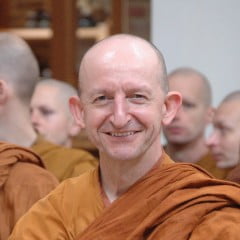
Ajahn Amaro

Born in England in 1956, Ajahn Amaro received his BSc. in Psychology and Physiology from the University of London. Spiritual searching led him to Thailand, where he went to Wat Pah Nanachat,... Voir plus

Born in England in 1956, Ajahn Amaro received his BSc. in Psychology and Physiology from the University of London. Spiritual searching led him to Thailand, where he went to Wat Pah Nanachat, a Forest Tradition monastery established for Western disciples of Thai meditation master Ajahn Chah, who ordained him as a bhikkhu in April 1979. He returned to England in October 1979 and joined Ajahn Sumedho at the newly established Chithurst Monastery in West Sussex.

In 1983 he made an 830-mile trek from Chithurst to a new branch monastery, Harnham Vihāra, near the Scottish border. In July 1985, he moved to Amaravati Buddhist Monastery north of London and resided there for many years. In the early 1990s, he started making trips to California every year, eventually establishing Abhayagiri Monastery near Ukiah, Northern California, in June of 1996.

He lived at Abhayagiri until the summer of 2010, holding the position of co-abbot along with Ajahn Pasanno. At that time, he then moved back to Amaravati Buddhist Monastery in England to take up the position of abbot of this large monastic community.

Cover for Less is More

Less is More

Ajahn Amaro (2020)
The theme for this afternoon’s talk is ‘Less is More – Frugality, Renunciation and Generosity’. I will focus on the frugality and renunciation aspects first of all and then get to generosity later on. First of all, it struck me how, if we say that our usual philosophy in life is ‘more is better’, if ‘less is more’, then ‘less is better’ – if you... Voir plus

The theme for this afternoon’s talk is ‘Less is More – Frugality, Renunciation and Generosity’. I will focus on the frugality and renunciation aspects first of all and then get to generosity later on.

First of all, it struck me how, if we say that our usual philosophy in life is ‘more is better’, if ‘less is more’, then ‘less is better’ – if you follow the logic – which is a good way of summarizing this theme.

This is an important topic for our times. Probably the kind of people who gather together at a Buddhist monastery on a Sunday afternoon are not those overly committed to consumption (what we call the ‘consumer society’ as if we were just a mouth with legs on) but that doesn’t have to be the way we see ourselves, even though this is often the way that society and our value systems are conditioned to operate. In the very wonderful little book called Buddhist Economics by Venerable Payutto, a Thai philosopher monk, he succinctly describes classic economics as: ‘Maximum consumption leads to maximum happiness.’ It’s the basic ethic of the consumer society. The more you consume then the happier you are. Even though we might say, ‘I’m a Buddhist, I’m not like that!’ I think it’s helpful to reflect that, if we look around and we see our working life, our family life, the society we live in, a huge amount of our conditioning is like that. The more that you’ve got, the happier you should be, so there’s an enormous amount of drive to get more. Maybe it’s not physical possessions but at least more status or more Facebook followers or more Instagram followers, more likes, as well as the usual more property, more money and more approval and so forth. So that ‘more is better’ as an ethic for our society is very strong I would suggest; even if we’re not overtly materialistic, or we don’t see ourselves that way, that can still be a very powerful driving force. That said, this is also not solely a modern thing – the search for happiness through material possessions, through the sensory world – this has been part of our life in the human realm since distant ages past.

Également disponible en ไทย
Cover for The Lesser, The Greater, The Diamond and the Way
HISTORICALLY THERE HAVE BEEN differences of opinion about the relative merits of Theravada and Mahayana Buddhism and, if you read much of the literature, they would seem to be quite divergent in their approaches toward Buddhist practice – yet there also seem to be some tremendous affinities. When I arrived at the International Forest Monastery in Thailand, I had never read any Buddhist books and... Voir plus

HISTORICALLY THERE HAVE BEEN differences of opinion about the relative merits of Theravada and Mahayana Buddhism and, if you read much of the literature, they would seem to be quite divergent in their approaches toward Buddhist practice – yet there also seem to be some tremendous affinities.

When I arrived at the International Forest Monastery in Thailand, I had never read any Buddhist books and I wasn’t actually in search of becoming a Buddhist monk. I was a wanderer, a free-lance spiritual seeker, and I just happened to turn up at this forest monastery that Ajahn Sumedho had established a couple of years before, basically as a place for a free meal and a roof over my head for a few nights. Little did I expect, some twelve or thirteen years later, that I would be doing what I am doing now. But when I went there and asked the monks about Buddhism, to explain things a little bit for me so that I could get a feel for what their life was about, the first thing one of them did was to give me a copy of a book of talks by a Zen Master, and he said, ‘Don’t bother trying to read the Theravada literature; it’s terribly boring, very dry. Read this, it is pretty much the same thing that we’re doing, and it will give you a sense of what our practice is about.’ And I thought, ‘Well, obviously these guys are not too hung up on their tradition.’ The book was Zen Mind, Beginner’s Mind.

So, one could see right from the beginning that, even though there is a strength to the particular form within any Buddhist country, one is not necessarily constricted or limited by that. I was there for months before I even heard of ‘Theravada’ and ‘Mahayana,’ let alone the differences of opinion between them. It seemed that when you actually lived the life there really wasn’t any great disparity, but if you thought about it a lot, and if you were the kind of person who wrote histories and books and had got into the political side of religious life, then that was where the divergences occurred.

I have heard Ajahn Sumedho recount a few times over the years that, for the first year of his monastic life, he had been practising using the instructions from a Ch’an meditation retreat given by the Ven. Master Hsü Yün, and that he had used the Dharma talks from that retreat given in China as his basic meditation instruction. When he went to Wat Pah Pong, Ajahn Chah asked him what kind of meditation he had been doing, at first he thought, ‘Oh no, he’s going to get me to give this up and do his method.’ But, when Ajahn Sumedho described what he had been doing and mentioned that it had had excellent results, Ajahn Chah said, ‘Oh, very good, just carry on doing that.’

So, one sees that there is a very strong unity of purpose; even though there might be historical differences between the two traditions, they are very much in accordance with each other. And one begins to see what the different Buddhist traditions are talking about. They get sectioned out into Hinayana or Mahayana or Vajrayana, as different types of Buddhist practice, but they are basically just different labels which are talking about attitudes of mind and, when the traditions are used wisely, then they will address all aspects of our mind, from the most selfish and mundane to the most exalted. They address all the different levels of our life, and it’s only when they are not understood, when people take them as fixed positions, that there is any conflict amongst them.
Également disponible en 中文(简体)
Cover for Not Sure!
Cover for Not Sure!

Not Sure!

Ajahn Amaro (2019)
The Dhamma talk was given on the 20th of June 2018 at the World Fellowship of Buddhists The topic for this evening is ‘Not Sure!’ Sitting on Sukhumvit Road and not moving in a vehicle, with the evening scheduled to begin at 6:30 and realizing it had already passed that time, I thought: ‘That’s a very good introduction for this evening – Not Sure! –... Voir plus

The Dhamma talk was given on the 20th of June 2018 at the World Fellowship of Buddhists

The topic for this evening is ‘Not Sure!’ Sitting on Sukhumvit Road and not moving in a vehicle, with the evening scheduled to begin at 6:30 and realizing it had already passed that time, I thought: ‘That’s a very good introduction for this evening – Not Sure! – When’s Ajahn Amaro going to arrive? Is he going to arrive? What will happen? It’s uncertain (My Naer). We don’t know. It’s not a sure thing.’ So that was an unplanned but useful preparation for this evening because this is the principle we are investigating here. It’s a part of all of our lives. So, I will offer a few reflections this evening on this theme and hopefully some of the things that I say would be useful for you.

When we meet with a feeling of uncertainty usually what we do is we feel worried, we feel threatened. We don’t know what’s going to happen in the future so what we tend to do is to try to fill up that unknown with a plan or a hope or a belief. We fill it with ideas of what might happen.

We often distract ourselves: ‘I don’t want to think about the future. I don’t want to worry about that. So, I’ll just look at my phone and catch up on my Facebook friends or see what communication I have coming through Line, what’s on the news or something.’ We thus deal with that feeling of worry or uncertainty with choosing distraction or, alternatively, we just switch off – we go blank, go numb and shut the world down, disengage all together. We do this because the feeling of not being sure is something that most of us don’t like and we relate to it as a problem, that feeling of anxiety, uncertainty. We automatically think of it as a problem, something that’s unwelcome.

Également disponible en ไทย
Cover for Emptiness and Pure Awareness
From a talk given on the winter retreat, Chithurst, February 1991 Gotama Buddha said, when he was an old man, “This body is like an old cart, held together by straps; this body only keeps going by makeshift repairs. The only way I can feel comfortable is to absorb my mind into signless concentration.” For all of us, the Buddha included, we are faced with... Voir plus

From a talk given on the winter retreat, Chithurst, February 1991

Gotama Buddha said, when he was an old man, “This body is like an old cart, held together by straps; this body only keeps going by makeshift repairs. The only way I can feel comfortable is to absorb my mind into signless concentration.”

For all of us, the Buddha included, we are faced with the inevitable presence of dissatisfaction and physical discomfort. Ever present is the danger of pain and disease, because we are born. Because there is a physical birth, there must be physical decay, the two have to go together, they are one thing. Thus our only true refuge is the Deathless, that which is not subject to disease, not subject to defilement, not subject to time or to limitation, that which is unsupported. In this way, returning to our source, the Deathless, is our only way to cure disease, the only way to pass beyond it.

This returning to the Source, or realizing the Deathless, is the sense of coming to know the source of our life, the origin of our life. Because it is the very fabric of our life, the basis of our existence, it is something that has been exerting a power of attraction on us all through our life, the attraction of Truth, of the Real, the completely satisfying, the completely safe.

Également disponible en ไทย
Cover for Mara and the Mangala I
This story is intended to be both a partner to the novel The Pilgrim Kamanita, written by Karl Gjellerup in 1906, and a tale that stands on its own. There is no need to have read the earlier book in order to make sense of this one; however, should you wish to go to the source from which many of the characters and scenes of... Voir plus

This story is intended to be both a partner to the novel The Pilgrim Kamanita, written by Karl Gjellerup in 1906, and a tale that stands on its own. There is no need to have read the earlier book in order to make sense of this one; however, should you wish to go to the source from which many of the characters and scenes of this tale have sprung, an English version of it is to be found here.

Cover for A Generous Heart
Today is the 100th day after the passing away of the king of Thailand: His Majesty King Bhumibol Adulyadej. Also, at this time, a good friend of the sangha, Yom Ploen Petchkua, is very close to the end of her life. She was diagnosed with five brain tumours a few months ago and I had the chance to go down and see her with Ajahn... Voir plus

Today is the 100th day after the passing away of the king of Thailand: His Majesty King Bhumibol Adulyadej. Also, at this time, a good friend of the sangha, Yom Ploen Petchkua, is very close to the end of her life. She was diagnosed with five brain tumours a few months ago and I had the chance to go down and see her with Ajahn Pasanno, and a number of monastic and lay friends in December, in her hometown in Songkla, southern Thailand.

Reflecting on these people – the king of Thailand and Yom Ploen – it is said in our Buddhist way of regarding things that these are people who have created a lot of merit, a lot of puñña in their lives. The king of Thailand dedicated himself, for the 70 years that he was on the throne, through living in a skilful way and endeavouring to establish wholesome principles of conduct in the hearts of the Thai people, to help them in genuine, practical and efficient ways: developing water systems, gardening systems, systems of communication and so forth. Yom Ploen has been very involved in supporting our monasteries and helping to publish many Dhamma books. In the last few days I have been conscious of giving away books that she was directly involved in producing books about the funeral of Luang Por Chah and the foundation of Amaravati. Over the years she has been responsible for bringing into being dozens of different Dhamma books.

Également disponible en ไทย
Cover for L’Ascolto Interiore – Meditazione sul Suono del Silenzio
Ci sono alcuni argomenti che i praticanti della meditazione buddhista conoscono bene: “la consapevolezza del respiro”, in cui ci si focalizza sul ritmo del respiro, “la meditazione camminata”, che ruota intorno alla sensazione dei passi mentre si cammina su e giù lungo un percorso prefissato, la ripetizione interna di un mantra, come “Bud-dho”. Tutte queste pratiche sono concepite per ancorare l’attenzione nella presenza di questo... Voir plus

Ci sono alcuni argomenti che i praticanti della meditazione buddhista conoscono bene: “la consapevolezza del respiro”, in cui ci si focalizza sul ritmo del respiro, “la meditazione camminata”, che ruota intorno alla sensazione dei passi mentre si cammina su e giù lungo un percorso prefissato, la ripetizione interna di un mantra, come “Bud-dho”. Tutte queste pratiche sono concepite per ancorare l’attenzione nella presenza di questo esatto momento, di questa realtà presente.

Insieme a questi metodi più conosciuti ce ne sono molti altri che possono essere utilizzati allo stesso scopo. Uno di questi è noto come “ascolto interiore” o “meditazione sul suono interiore”, o ancora, in sanscrito, “nada yoga”. Questi termini si riferiscono tutti al metodo in cui si presta attenzione a quello che è stato chiamato “il suono del silenzio”, o “il suono-nada”. “Nada” è la parola sanscrita per “suono”, come pure la parola spagnola per “nulla”. Una coincidenza interessante e – del tutto casualmente – significativa.

Ce livre est une traduction de Inner Listening
Cover for The Hush At The End Of The World
In May of 2003, three senior Buddhist monks from the Thai forest tradition of Ajahn Chah – Ajahn Sumedho, Ajahn Amaro and Ajahn Nyanarato – travelled into the Arctic wilderness, 800 miles from the North Pole. This is a photo-journal of their odyssey.
Cover for Roots and Currents
This book contains a miscellany of my writings, rather than transcribed talks, from throughout my life as an ajahn in the Western Thai Forest sangha. The first part, ‘Roots’, is mainly historical; its chapters introduce Ajahn Chah, our founder and inspiration, and Ajahn Sumedho who led us to the UK and beyond, and then describes various events in our Western history.
Également disponible en Português
Cover for The Breakthrough
This book is based upon the talks and meditation instructions offered during a thirteen-day retreat at Amaravati, in the summer of 2012. It is intended to be something of a follow up to Finding the Missing Peace, which was published in 2011 and presented as ‘a primer of Buddhist meditation’. The Breakthrough is intended to be a somewhat more specialized toolkit, describing the path of... Voir plus

This book is based upon the talks and meditation instructions offered during a thirteen-day retreat at Amaravati, in the summer of 2012. It is intended to be something of a follow up to Finding the Missing Peace, which was published in 2011 and presented as ‘a primer of Buddhist meditation’. The Breakthrough is intended to be a somewhat more specialized toolkit, describing the path of Buddhist meditation in an in-depth way, specifically highlighting the role of wisdom and reflective investigation in the development of insight and thereby psychological freedom. The title The Breakthrough comes from the Pali word ‘abhisamaya’. The word, as used by the Buddha, is synonymous with the first level of liberation, known as ‘stream-entry’ – the ‘stream’ in question being the Eightfold Path, which leads to full emancipation, enlightenment. As is described in these pages, this breakthrough is considered to be a spiritual turning point of great significance. It marks the point on the spiritual journey beyond which enlightenment is assured and freedom guaranteed.

Également disponible en Español, 中文(简体)
Cover for The Pilgrim Kamanita
THE BOOK YOU ARE VIEWING HERE is the eBook of the second print edition of The Pilgrim Kāmanīta – a Legendary Romance, published in 2017. The text of the story is largely unchanged from the 1999 and the 2008 editions, although – poetic licence of the author notwithstanding – a few more factual errors have been corrected. There have also been a few additions and... Voir plus

THE BOOK YOU ARE VIEWING HERE is the eBook of the second print edition of The Pilgrim Kāmanīta – a Legendary Romance, published in 2017. The text of the story is largely unchanged from the 1999 and the 2008 editions, although – poetic licence of the author notwithstanding – a few more factual errors have been corrected. There have also been a few additions and amendations to the Notes and References since, over the years, more of the author’s sources have become apparent.

Another significant addition to the book has come through the editor having received a copy of the 1995 Boiselle-Löhmann Verlag edition of Der Pilger Kamanita – a photo-reproduction of the original work in German. This edition valuably contained the substantial Note on the text by the author, Karl Gjellerup, which the Thai edition we had been working from had omitted. This Note adds some fresh insight into the chemistry of the tale’s ripening in the commodious brew-pot of the author’s imagination, we are thus very glad to be able to include it here.

Également disponible en Español, Français
Cover for Who is Pulling the Strings?
This small book is the fourth in a series of four, consisting of reflections and practices related to the ‘sublime abiding places for the heart’ – the four brahma-vihāras, in Buddhist parlance. The vision for the series is to explore these sublime abidings via the somewhat oblique approach of looking at their opposites. In this last book we will be investigating upekkhā and this through... Voir plus

This small book is the fourth in a series of four, consisting of reflections and practices related to the ‘sublime abiding places for the heart’ – the four brahma-vihāras, in Buddhist parlance. The vision for the series is to explore these sublime abidings via the somewhat oblique approach of looking at their opposites. In this last book we will be investigating upekkhā and this through the lens of superstitious views about why and how things happen as they do. This might seem a very unusual approach to the development of this sublime quality, said to be the most subtle and expansive of the brahma-vihāras, however, one of the Buddha’s most common reflections to support the cultivation of upekkhā is precisely and solely an investigation of causality: ‘I am the owner of my action, companion to my to my action … whatever action I do, for good or for ill, of that I will be the heir.’

Également disponible en Español
Cover for Phra Videsabuddhiguṇa (Venerable Ajahn Amaro)
This small book is an expression of the good wishes of many sincere and devoted people. It is a gesture of their faith in the Triple Gem and, in particular, in the life and teaching of Venerable Ajahn Chah and the community of his students. On December the 5th, 2015, Luang Por Pasanno, of Abhayagiri Monastery in California, and Ajahn Amaro, of Amaravati Monastery in... Voir plus

This small book is an expression of the good wishes of many sincere and devoted people. It is a gesture of their faith in the Triple Gem and, in particular, in the life and teaching of Venerable Ajahn Chah and the community of his students.

On December the 5th, 2015, Luang Por Pasanno, of Abhayagiri Monastery in California, and Ajahn Amaro, of Amaravati Monastery in England, were given the honorary titles of Jao Khun by H.M. the King of Thailand, in a ceremony at the Temple of the Emerald Buddha. Luang Por Pasanno received the new name Bodhiñāṇavides, resonating Luang Por Chah’s honorific name of Bodhiñāṇathera, whilst Ajahn Amaro received the name Videsabuddhiguṇa. This book you are holding has been produced as a result of their having been offered these titles and in celebration of the wholesome qualities that such public recognition is designed to encourage.

Également disponible en ไทย
Cover for Just One More…
This small book is the third in a series of four, consisting of reflections and practices related to the ‘sublime abiding places for the heart’ – the four brahma-vihāras, in Buddhist parlance. The vision for the series is to explore these sublime abidings via the somewhat oblique approach of looking at what counters or muddies their activity. In this third book we will be investigating... Voir plus

This small book is the third in a series of four, consisting of reflections and practices related to the ‘sublime abiding places for the heart’ – the four brahma-vihāras, in Buddhist parlance. The vision for the series is to explore these sublime abidings via the somewhat oblique approach of looking at what counters or muddies their activity. In this third book we will be investigating muditā through the lens of self-centred desire and its relationship to dissatisfaction; how the quest to fulfil personal cravings leads not to joy but rather to pain-haunted addictions; how joy, instead, comes from unselfishness, giving and consciously delighting in the blessings that others have; how those blessings of others need not feed a sense of lack or unworthiness in us but rather, marvellously and mysteriously, be a contributor to our own well-being.

Également disponible en Español
Load more