3 filtros

Ajahn Amaro

English, 中文(简体)

Para explorar nuestras publicaciones en otros idiomas, haz clic en "Borrar" o navega por la lista de idiomas en el menú a la izquierda.

Borrar

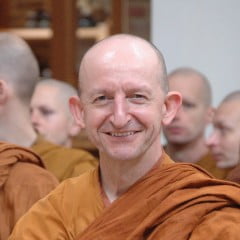
Ajahn Amaro

Born in England in 1956, Ajahn Amaro received his BSc. in Psychology and Physiology from the University of London. Spiritual searching led him to Thailand, where he went to Wat Pah Nanachat,... Leer más

Born in England in 1956, Ajahn Amaro received his BSc. in Psychology and Physiology from the University of London. Spiritual searching led him to Thailand, where he went to Wat Pah Nanachat, a Forest Tradition monastery established for Western disciples of Thai meditation master Ajahn Chah, who ordained him as a bhikkhu in April 1979. He returned to England in October 1979 and joined Ajahn Sumedho at the newly established Chithurst Monastery in West Sussex.

In 1983 he made an 830-mile trek from Chithurst to a new branch monastery, Harnham Vihāra, near the Scottish border. In July 1985, he moved to Amaravati Buddhist Monastery north of London and resided there for many years. In the early 1990s, he started making trips to California every year, eventually establishing Abhayagiri Monastery near Ukiah, Northern California, in June of 1996.

He lived at Abhayagiri until the summer of 2010, holding the position of co-abbot along with Ajahn Pasanno. At that time, he then moved back to Amaravati Buddhist Monastery in England to take up the position of abbot of this large monastic community.

Cover for Mara and the Mangala II
This story is intended to be a partner to the two novels ‘The Pilgrim Kamanita ~ A Legendary Romance’, written by Karl Gjellerup in 1906, and ‘The Killer ~ Mara and the Mangala, Book I’, written by myself, published in 2019. This present book exists as a tale that both stands on its own and serves as a continuation of the stories in the previous... Leer más

This story is intended to be a partner to the two novels ‘The Pilgrim Kamanita ~ A Legendary Romance’, written by Karl Gjellerup in 1906, and ‘The Killer ~ Mara and the Mangala, Book I’, written by myself, published in 2019.

This present book exists as a tale that both stands on its own and serves as a continuation of the stories in the previous volumes. There is no need to have read the earlier books in order to make sense of this one; however, should the reader wish to go to the source from which many of the characters and scenes of this tale have sprung, the previously published books can be found here and here.

In the tradition of such eminent authors as Charles Dickens, Sir Arthur Conan Doyle and Alexandre Dumas, the present book is being released as a serial novel, one chapter every fortnight, over the years 2025-26. It is planned that, once all the chapters have been released, an edition of the whole story will be published as a single book.

One of the worst things that can happen to a tale to be read for pleasure is to have it surrounded by footnotes and appendices. This is true; but it’s also true that some readers might like to know: ‘Did this come from the Buddha?’ ‘Where can I find the rest of that quote?’ ‘Did that really happen!?’

An appendix of notes and references has therefore been created, which outlines the sources of the derived material that has been used. The main body of the text is not marked in any way to indicate these notes; however, if the reader is curious about a certain passage, they can go to the end of the chapter, look for the page and quotation in question, and see if there’s a comment or reference for it. In this way, if one just wants to read the story and ignore the rest one can easily do so but, if one is interested in finding out more and checking the facts, the origins are mostly outlined there.

Also, gentle reader, please note that the original author (Karl Gjellerup) switched freely between using Sanskrit (the language of the Northern Buddhist and Hindu scriptures) and Pali (the language of the Southern Buddhist scriptures) during the course of his foundational tale. In our efforts to be true to his style this mixture of usage has been maintained in the two subsequent volumes.

Ajahn Amaro
Amaravati Monastery
Spring, 2025

Cover for Happily Ever After. 5 Beyond
Reflections on life goals and priorities. In this volume: - The good, the bad and the unconditioned - ‘We need to talk about Nibbāna’ - Suchness and the square root of minus one - Unshakeable well-being - ... Happily ever after
Cover for Happily Ever After. 4 Money
Reflections on life goals and priorities. In this volume: - Buddhism and the pursuit of wealth - ‘How to live a Dhamma life in the capitalist world of today?’ - A currency of well-being
Cover for Happily Ever After. 2 Emotion
Reflections on life goals and priorities. In this volume: - ‘Heroin or chocolate cake?’ - ‘I am a Buddhist, why am I so angry?’ - The importance of being bored, sad and lonely - ‘If you truly love me, don’t create me in your mind’
Cover for Happily Ever After. 1 Reality
Reflections on life goals and priorities. In this volume: - ‘The Blue Pill or the Red Pill? Why Wake up When my Habits are so Pleasant?’ - ‘Of course it’s happening in your head, Harry, but why on earth should that mean that it is not real?’ - Let the citta draw a picture
Cover for Serenity Is the Final Word
"I thought I would begin by offering a few reflections about equanimity or upekkhā. This is one of the most significant psychological, emotional qualities talked about in the Buddhist tradition. However, because we commonly translate the word upekkhā in English as ‘equanimity’, it can easily be overlooked or seen as something a bit insignificant, not so practical or even heartwarming, as the word ‘equanimity’ in... Leer más

"I thought I would begin by offering a few reflections about equanimity or upekkhā. This is one of the most significant psychological, emotional qualities talked about in the Buddhist tradition. However, because we commonly translate the word upekkhā in English as ‘equanimity’, it can easily be overlooked or seen as something a bit insignificant, not so practical or even heartwarming, as the word ‘equanimity’ in English can easily mean ‘indifference’, not really caring – it can be taken to be a switched-off, disconnected and somewhat numb attitude towards things."

Based on a talk given at Amaravati – 26-4-2020

También disponible en ไทย
Cover for 突破入流初果
此书集结了阿马拉瓦蒂寺院 (Amaravati Monastery) 在 2012 年夏天举办的 13 天密集禅修时的开示,也可以说是《找回失去的宁静》这本书的延续。《找回失去的宁静》发表于 2011 年,是关于禅修的入门指引。与之相比,《突破入流初果》的定位更像是专用的工具箱,尤其强调智慧和内省在发展觉悟和心灵解脱中扮演的角色。 入流初果是声闻四果中的第一果,所谓“入流”,就是走入八正道,引向最终的觉悟解脱。之所以称为“突破”,是因为它是心灵修行上的一个转折点,具有重要的意义,一旦实现入流初果,最终的方向必然将是自由和解脱。 此书引用了大量佛经故事、作者的亲身经历以及其他相关事例来阐述重要的佛理,比如对“佛、法、僧”更深一层的理解,以及“十二缘起”、“戏论”是如何运作的,“自我”又是如何被构建的。还详细介绍了不同的禅修方法,包括基本的坐禅、行禅、身念住、内观禅,以及对“苦”、“无常”、“非我”的省思,对寂静之音、时间、空间的观照等,并对禅修中可能遇到的困难给出了实用的建议。对佛理的进一步理解和禅修的持续精进,能够帮助我们减轻甚至消除“身见结”、“戒禁取结”、“疑结”,在心灵追求的道路上实现不可逆转的解脱智慧。
Este libro es una traducción de The Breakthrough
Cover for My Way or The Middle Way
The theme for this Dhamma talk is ‘My way or the Middle Way?’ As people might recognize, the title was borrowed from the famous Frank Sinatra song, written by Paul Anka, ‘My Way’, which is the supreme anthem of self-confidence: Through it all, when there was doubt, I ate it up and spit it out. I faced it all and I stood tall, And did... Leer más

The theme for this Dhamma talk is ‘My way or the Middle Way?’ As people might recognize, the title was borrowed from the famous Frank Sinatra song, written by Paul Anka, ‘My Way’, which is the supreme anthem of self-confidence:

Through it all, when there was doubt, I ate it up and spit it out. I faced it all and I stood tall, And did it my way!’

Confidence is definitely a part of the Buddhist path; having faith, having confidence and resolution, these are all aspects of it. But any of us who have spent much time in life trying to follow that voice of self-assurance, of, ‘Even though there is resistance and it is difficult, I’m just going to keep pushing. I will do it my way.’ Or when we are living in a community, or we are in a role of leadership, if we adopt the attitude of, ‘My way or the highway. Either you do it the way I want or you’re on your bike, you are kicked out’ – that leads to stress and difficulty and conflict. Reflecting on this theme, ‘My way or the Middle Way’, there are certainly beneficial aspects to the quality of self-confidence, self-assurance and resolution, but if that is out of balance, if that is wrapped up in self-view and selfcentred thinking, then necessarily the results are going to be painful. You might get what you want but then there might be a lot of wreckage as well, considerable damage created along the way. Probably most of us have had some situations in life where we have come to the conclusion, ‘Well, I got what I wanted, but was it really worth it?’ or ‘I didn’t realize it was going to be like this.’ Or ‘I thought this was going to make me happier. I got what I wanted but ugh!’

In terms of this theme and what would be useful for us to look at, I feel that it is good to consider the way that we work in life – how we relate to doing, to acting, to choosing, how intentions and actions work together. When we use the kind of confidence expressed by Frank Sinatra, ‘I am going to do it my way!’ if we take that approach in life and we act from a place of self-assertion and we just keep pushing – whether this is with our occupation, or working with our family, or working with the rest of the traffic on the road – if we have that kind of contentious attitude, ‘I am going to make this happen,’ since that is wrapped up with self-view, then any kind of work becomes exhausting. Even when we are working with our minds in the meditation hall, thinking, ‘I am going to get jhāna. I am going to make the Breakthrough, it’s Stream Entry or bust!’ This is a guaranteed way to create suffering. Even the work of training our mind to be peaceful can be stressful and exhausting if that work is based on self-view.
También disponible en ไทย
Cover for Copper Isle Miles
This photo-journal records a pilgrimage made in Sri Lanka in November of 2019. I had been invited numerous times to visit this ancient seedbed of Theravāda Buddhism but, prior to this present occasion, had always declined the offers. Thee reason for this was not a disinterest in the country, with its ancient Buddhist traditions and numerous holy places, rather it was that, if I was... Leer más

This photo-journal records a pilgrimage made in Sri Lanka in November of 2019. I had been invited numerous times to visit this ancient seedbed of Theravāda Buddhism but, prior to this present occasion, had always declined the offers. Thee reason for this was not a disinterest in the country, with its ancient Buddhist traditions and numerous holy places, rather it was that, if I was going to go, I wanted to go quietly as a pilgrim and not on a teaching tour or part of a bustling group of devotees. Sometimes I wondered if I was being too fussy or narrow on this score but, in retrospect, I am very glad to have waited for forty years to make the journey.

Cover for Catastrophe/Apostrophe: The Buddha’s Teachings on Dependent Origination/Cessation
Over the last few years I have led residential retreats specifically on the theme of dependent origination on at least five occasions – at Amaravati in the U.K., in Mae Rim, Thailand, and with Le Refuge, at Monastère de Ségriès, in the south of France. Various aspects of this rich, essential theme of Buddhist teaching have been focused upon in these different situations, according to... Leer más

Over the last few years I have led residential retreats specifically on the theme of dependent origination on at least five occasions – at Amaravati in the U.K., in Mae Rim, Thailand, and with Le Refuge, at Monastère de Ségriès, in the south of France. Various aspects of this rich, essential theme of Buddhist teaching have been focused upon in these different situations, according to the interests and needs of the various communities. The booklet entitled ‘Just One More…’ – Appreciative Joy: Jealousy, Selfish Desire and the Buddha’s Teaching on the Cycles of Addiction was based on the material from one of these events, a ten-day retreat held at Amaravati in July 2013. Most of the material gathered in this present book was presented at a retreat in Provence, in April 2018; the remainder is from the Mae Rim retreats of 2016-18.

The subject of dependent origination is intrinsically rich and varied, subtle and multi-dimensional, as the Buddha expressed in this notable exchange with his disciple and attendant Ven. Ānanda:

Thus have I heard. On one occasion the Blessed One was living among the Kurus, near a town of theirs named Kammāsadhamma. There Ven. Ānanda approached the Blessed One and, on arrival, having bowed down to the Blessed One, sat to one side. As he was sitting there he said to the Blessed One: ‘It’s wonderful, venerable sir, it’s marvellous, how profound this dependent origination is, and how profound its appearance, and yet to me it appears as clear as clear can be.’ ‘Do not say that, Ānanda! Do not say that! This dependent origination is profound and it appears profound. It is through not understanding and not penetrating this Dhamma that this generation has become like a tangled ball of string, matted like a bird’s nest, tangled like coarse grass and is unable to pass beyond the cycles of rebirth, beyond the planes of deprivation, woe and bad destinations.’ (D 15.1)

There have already been many erudite and wise explorations of the subject published in English, such as Dependent Origination – The Buddha’s Law of Conditionality by Ven. P.A. Payutto; the collection of five chapters on the theme in Ajahn Sumedho’s book The Way It Is; Ajahn Buddhadāsa’s book Under the Bodhi Tree: Buddha’s Original Vision of Dependent Co-arising, as well as many others. The intention of this present volume, whilst acknowledging the already great storehouse of perspectives available, is to focus upon practical means of understanding and applying the principles of dependent origination in order to support the freeing of the heart from addictive and destructive cycles of attitude and behaviour. In particular the emphasis will be on the exit points from this ‘Wheel of Becoming’ (bhavacakka) this cyclical process where the mind feels itself to be imprisoned in a habitual round of promise, gratification and disappointment.

También disponible en Français
Cover for Mind Is What Matters: the Phenomenological Approach of the Buddha
THE TITLE OF THIS BOOK, Mind Is What Matters, brings attention to attitude. It points to the enormous difference our attitude makes as the mind receives and processes experience, and it points to that aspect of Dhamma practice of making everything our teacher. In 2017 at our open retreat at Amaravati Monastery, there were over 400 people attending. Ajahn Sumedho gave teachings every evening, and... Leer más

THE TITLE OF THIS BOOK, Mind Is What Matters, brings attention to attitude. It points to the enormous difference our attitude makes as the mind receives and processes experience, and it points to that aspect of Dhamma practice of making everything our teacher. In 2017 at our open retreat at Amaravati Monastery, there were over 400 people attending. Ajahn Sumedho gave teachings every evening, and other visiting ajahns offered instruction and led question-and-answer sessions daily. For some of us, it was a very inspiring time. There were a lot of illuminating and imaginative teachings; for me it was a truly encouraging and beautiful event. But what if someone else’s attitude had been different? Even though they were hearing inspiring teachings, they could have begun to think they were not enough. Or they could have compared one teacher to another, judging who was better. Even something as noble, beautiful, and wholesome as hearing Dhamma teachings could have become a cause of suffering, disappointment or discontent if the person had taken hold of the experience in an unskilful way. Our minds can easily get caught in judgment: ‘this’ is not as good as ‘that’, or ‘now’ is not quite as real or good as ‘that prospect off in the future’ or ‘that great time back in the past’. If this is what our mind is doing, we can look at it. This feeling of disappointment, this comparing mind, can become our teacher in this moment. If we are wise, everything will teach us: the weather, our memories, our physical condition, the environment, the people around us.

In addition to the Thai version, a mixed English/Thai one is also available.

También disponible en Deutsch, ไทย
Cover for Forgiving and Compassion
Sunday Talk on the 18th September 2016 Good afternoon to you all. The theme for the Sunday talk this week is ‘Forgiving and Compassion’ so I will offer some reflections around these significant areas of our lives. I will start with forgiving. This is a very important aspect of spiritual training and, as a way of life, it is a counterpoint to the attitude of... Leer más

Sunday Talk on the 18th September 2016

Good afternoon to you all. The theme for the Sunday talk this week is ‘Forgiving and Compassion’ so I will offer some reflections around these significant areas of our lives. I will start with forgiving.

This is a very important aspect of spiritual training and, as a way of life, it is a counterpoint to the attitude of being unforgiving, the attitude of wanting revenge, carrying grudges around. It’s about working with those attitudes of mind where we are determined to hang onto our negativity and our hurts, and to wear those proudly upon our sleeves – all the wrongs that have been done to me, the things that were unforgivable – that we are habitually conditioned to carry around and make much of. Sometimes people find themselves building their entire lives around wanting revenge, or resenting something that’s happened to them in their life, there’s something in the heart that can’t forgive.

When I speak in this way, in case any of you are wondering, I’m not reading anybody’s mind. Oftentimes when one starts talking about these themes people think, ‘How did he know!’ Please be reassured that it’s just averages, the law of statistics and how life is for many of us. I cannot read people’s minds.

También disponible en ไทย
Load more