1 filtre

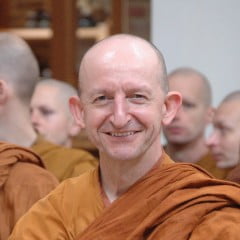
Ajahn Amaro

Netejar

Ajahn Amaro

Born in England in 1956, Ajahn Amaro received his BSc. in Psychology and Physiology from the University of London. Spiritual searching led him to Thailand, where he went to Wat Pah Nanachat,... Llegir més

Born in England in 1956, Ajahn Amaro received his BSc. in Psychology and Physiology from the University of London. Spiritual searching led him to Thailand, where he went to Wat Pah Nanachat, a Forest Tradition monastery established for Western disciples of Thai meditation master Ajahn Chah, who ordained him as a bhikkhu in April 1979. He returned to England in October 1979 and joined Ajahn Sumedho at the newly established Chithurst Monastery in West Sussex.

In 1983 he made an 830-mile trek from Chithurst to a new branch monastery, Harnham Vihāra, near the Scottish border. In July 1985, he moved to Amaravati Buddhist Monastery north of London and resided there for many years. In the early 1990s, he started making trips to California every year, eventually establishing Abhayagiri Monastery near Ukiah, Northern California, in June of 1996.

He lived at Abhayagiri until the summer of 2010, holding the position of co-abbot along with Ajahn Pasanno. At that time, he then moved back to Amaravati Buddhist Monastery in England to take up the position of abbot of this large monastic community.

Cover for Piccola Barca, Grande Montagna
AGLI INIZI DEGLI ANNI ’80 ero un giovane monaco che viveva e praticava al Wat Suan Mokkh, un monastero della foresta nel sud della Thailandia fondato da Ajahn Buddhadāsa, uno dei più grandi studiosi e insegnanti di meditazione thailandesi degli ultimi 50 anni. Ho un profondo apprezzamento nei confronti del lignaggio Theravāda di questo paese, per la sua totale fedeltà agli insegnamenti originali del Buddha,... Llegir més

AGLI INIZI DEGLI ANNI ’80 ero un giovane monaco che viveva e praticava al Wat Suan Mokkh, un monastero della foresta nel sud della Thailandia fondato da Ajahn Buddhadāsa, uno dei più grandi studiosi e insegnanti di meditazione thailandesi degli ultimi 50 anni. Ho un profondo apprezzamento nei confronti del lignaggio Theravāda di questo paese, per la sua totale fedeltà agli insegnamenti originali del Buddha, così come ci sono stati tramandati attraverso il Canone pāli.

Mi trovavo a Suan Mokkh da poco tempo e una mattina, mentre facevamo colazione nel refettorio all’aperto, mi sorpresi nel vedere nelle vicinanze, in cima a un piedistallo alto quasi due metri, un busto di Avalokiteshvāra, il dio Mahāyāna della compassione. Mi chiesi cosa ci facesse una divinità Mahāyāna proprio lì, in un monastero Theravāda. Le due tradizioni si sono separate nell’India del nord 2000 anni fa. In quel momento credevo, e mi sbagliavo, che non si fossero mai più parlate, come una coppia astiosa senza figli dopo il divorzio.

Aquest llibre és una traducció de Small Boat, Great Mountain
Cover for Rain on the Nile
When Silent Rain was first compiled, back in 1993, part of the idea of producing such a varied collection of material – talks, poems, travelogues and artwork – was that it would then provide an easy source for smaller offprints over the years. Things, however, rarely turn out as predicted by foresight and thus, up until now, no smaller booklets had been spawned from it.... Llegir més

When Silent Rain was first compiled, back in 1993, part of the idea of producing such a varied collection of material – talks, poems, travelogues and artwork – was that it would then provide an easy source for smaller offprints over the years. Things, however, rarely turn out as predicted by foresight and thus, up until now, no smaller booklets had been spawned from it.

This present book, Rain on the Nile, is something of a remedy for that, being both an outcome of that original intention as well as an arena for the offering up of some more recent material – to wit, the travelogue of a journey to Egypt made in December of 2006. In truth, without there having been plans to reprint some of the talks from Silent Rain, the Egyptian diary would never have been written.

The idea to select some talks from the book and to create this smaller reprint was originally that of Venerable Tenzin Chogkyi, an American nun practicing in the Tibetan tradition. She had been the recipient of a bequest from a family member and was of a mind to direct some of it to be used to bring parts of Silent Rain back into circulation, the original stock of books having long ago been exhausted. She had found the book very helpful in her own life and wished it to be accessible to others. She thus approached me, in the autumn of 2006, and floated the idea of such an offprint being sponsored by her. I readily agreed and, during the conversation, it was mentioned that I had plans to travel to Egypt with Luang Por Sumedho that December.

També disponible en Español
Cover for Tudong, The Long Road North
Tudong is a Thai derivative of the Pali word dhutanga translating literally as ‘means of shaking off’; it is used to refer to the austere or ascetic practices allowed by the Buddha for his disciples. These practices are thirteen in number and include, for example: eating only one meal a day, eating all your food together in your alms-bowl, never lying down, only wearing robes... Llegir més

Tudong is a Thai derivative of the Pali word dhutanga translating literally as ‘means of shaking off’; it is used to refer to the austere or ascetic practices allowed by the Buddha for his disciples. These practices are thirteen in number and include, for example: eating only one meal a day, eating all your food together in your alms-bowl, never lying down, only wearing robes made from scraps of thrown-away cloth, taking the shade of a tree as your only shelter. These practices are seen as a ‘means of shaking off’ since austerity of lifestyle, when rightly applied, can be greatly conducive to the development of wisdom and insight – that is, the shaking off of one’s delusions.

The word tudong is also used to refer to those monks who adhere closely to the monastic discipline and whose practice of the Buddha’s teachings is based on meditation and the cultivation of these dhutangas. Both the monastic discipline and the additional constraints of the dhutanga practices are tools used to help contain the mind. This containment is achieved as they prevent or make clear the tendencies of the mind to ‘flow out’; that is, absorb into the likes […]”

Cover for Rugged Interdependency
Perhaps it is impossible to say where anything really begins, nevertheless, it can be useful to map out a few landmarks here and there. Accordingly, here is a little of the background against and amongst which much of the thread of these travelogues unravels. In the early 1980s Ajahn Sumedho began to make regular visits to northern California. He was the senior Western disciple of... Llegir més

Perhaps it is impossible to say where anything really begins, nevertheless, it can be useful to map out a few landmarks here and there. Accordingly, here is a little of the background against and amongst which much of the thread of these travelogues unravels.

In the early 1980s Ajahn Sumedho began to make regular visits to northern California. He was the senior Western disciple of Ajahn Chah, one of the most highly respected Buddhist masters of the Thai forest tradition of Theravāda Buddhism, and he had been invited to come and teach in the US by Jack Kornfield, a former Peace Corps volunteer and psychologist, with whom he had spent some time in Thailand, in the late ’60s, when they were both monks under Ajahn Chah’s tutelage.

Jack had left the monk’s robes after returning to the States in the early ’70s and, with his friends Sharon Salzberg, Joseph Goldstein and Jacqueline Schwarz (now Mandell), had embarked upon establishing the Buddhist retreat center in Massachusetts called Insight Meditation Society (IMS). This had met with great success but had also revealed some differences in styles of teaching and practice amongst the founders. These differences, along with the massive interest in Buddhist meditation that was brewing in northern California, led Jack back to his city of origin, San Francisco, to found a parallel center to IMS on the West Coast. When it eventually came into being the new place became known as Spirit Rock Meditation Center.

These annual invitations to California were doubly attractive to Ajahn Sumedho in that, not only being an American and an alumnus of Berkeley University and thus being given a chance to visit his old stomping grounds, they also gave him the opportunity to visit his elderly parents and sister in San Diego. It therefore duly became part of his annual schedule to step out of the many duties he had in the foundation of his new monasteries in England (Cittaviveka in West Sussex and Amaravati in Hertfordshire) and to head to the West Coast for a few weeks to teach and to see family.

Over the next ten years he developed a devoted following of students in the San Francisco Bay Area. In 1988 they formed the Sanghapala Foundation, with the mission of creating a branch Monastery of Ajahn Chah’s lineage somewhere in northern California. Dr. Marc Lieberman, Nancy Garfield, Debbie Stamp and […]”

Cover for An Introduction to the Life and Teachings of Ajahn Chah
One evening in Northeast Thailand… Night is falling swiftly. The forest reverberates with the undulating buzz of countless crickets and the eerie rising wail of tropical cicadas. A few stars poke dimly through the treetops. Amid the gathering darkness there is a pool of warm light, thrown from a pair of kerosene lanterns illuminating the open area below a hut raised up on stilts. Beneath... Llegir més

One evening in Northeast Thailand…

Night is falling swiftly. The forest reverberates with the undulating buzz of countless crickets and the eerie rising wail of tropical cicadas. A few stars poke dimly through the treetops. Amid the gathering darkness there is a pool of warm light, thrown from a pair of kerosene lanterns illuminating the open area below a hut raised up on stilts. Beneath their glow, a couple of dozen people are gathered around a small, solidly-built monk who is seated cross-legged on a wicker bench. The air is filled with a vibrant peace. Venerable Ajahn Chah is teaching.

In some ways the group gathered here is a motley crew. Close beside Ajahn Chah (or Luang Por, Venerable Father, as he is affectionately known to his students) is a cluster of bhikkhus (monks) and novices; most of them are Thai or Lao, but there are a few pale-skinned figures among them – a Canadian, two Americans, a young Australian and an Englishman. In front of the Ajahn sits a well-groomed middle-aged couple, he in a stiff suit and she coiffed and gold-bedecked – he’s a member of parliament from a distant province, they’re taking […]

També disponible en italiano
Cover for Silent Rain
In the way of spiritual life, creation tends to happen through response to circumstances rather than from any self-propelled initiative. In the summer of 1993, whilst I was doing some teaching in Detroit for a few days, I was asked if I had ever written a book. I replied, “Yes, but it’s long out of print.” “Could it be reprinted?” came the inquiry. “Theoretically yes,... Llegir més

In the way of spiritual life, creation tends to happen through response to circumstances rather than from any self-propelled initiative.

In the summer of 1993, whilst I was doing some teaching in Detroit for a few days, I was asked if I had ever written a book. I replied, “Yes, but it’s long out of print.” “Could it be reprinted?” came the inquiry. “Theoretically yes, of course….”

Before I knew it donations for such a reprint started to be offered in quantity. The book in question, by the way, was Tudong – The Long Road North, which I had written in 1984 following a long walk that I had made through England. We had only printed a thousand copies at the time and they were long gone by now.

When I mentioned to some other supporters in San Francisco a few days later that reprinting Tudong was in the air, they suggested: “Why not put together a collection of more recent stuff instead?” “Good idea,” I thought. “That makes sense ….” On returning to England I talked the possibility over with Ajahn Sucitto – the monk who looks after all our publications – who responded by saying, “Great. You could include some of those travelogues, and maybe some poems of yours ….” It thus gathered momentum and its own life began to unfold.

As the text selected itself and grew I began to think of illustrations that might he used to round out the book. There were a number that had already been produced for various Sangha publications, and ones that I had drawn over the years for members of my family. I gathered these together and found a few that seemed to match the different moods and themes of the book.

“What you are now holding in your hands therefore is the confluence of all these elements. More than anything else it is a scrapbook – a simple cross-section through the world of someone who, in this late 20th Century time, has chosen to live as a Buddhist monk. In putting this book together, every effort has been made to render it as accessible as possible. If, however, at some point its meaning or reason escapes you, hopefully the music will tide you over.

Amaro Bhikkhu Troy November 1994”
Cover for The Island
A difficulty with the word ‘nibbāna’ is that its meaning is beyond the power of words to describe. It is, essentially, undefinable. Another difficulty is that many Buddhists see Nibbāna as something unobtainable – as so high and so remote that we’re not worthy enough to try for it. Or we see Nibbāna as a goal, as an unknown, undefined something that we should somehow... Llegir més

A difficulty with the word ‘nibbāna’ is that its meaning is beyond the power of words to describe. It is, essentially, undefinable.

Another difficulty is that many Buddhists see Nibbāna as something unobtainable – as so high and so remote that we’re not worthy enough to try for it. Or we see Nibbāna as a goal, as an unknown, undefined something that we should somehow try to attain.

Most of us are conditioned in this way. We want to achieve or attain something that we don’t have now. So Nibbāna is looked at as something that, if you work hard, keep the sīla, meditate diligently, become a monastic, devote your life to practice, then your reward might be that eventually you attain Nibbāna – even though we’re not sure what it is.

També disponible en Deutsch, Español
Cover for Like A River
Todd’s life was like a river that flows gently to make all who came to know him happy. He always cared about others without expecting anything in return. He shared his favorite toys, lunch money and allowances with friends in need, not to mention the many sweet smiles to encourage people to be happy. He taught us to be generous, kind, caring and forgiving. As... Llegir més

Todd’s life was like a river that flows gently to make all who came to know him happy. He always cared about others without expecting anything in return. He shared his favorite toys, lunch money and allowances with friends in need, not to mention the many sweet smiles to encourage people to be happy. He taught us to be generous, kind, caring and forgiving. As one of his buddies, Stephen, put it, “Todd was one of a kind, like finding a needle in the haystack. I will miss him.” Adopting Todd is the best decision that we made in our lives, and we continue to be thankful to have had him as our child.

Cover for Kleines Boot, erhabener Berg
[...] Wir können uns äußerst glücklich schätzen, dass der Buddhismus im Westen noch so neu ist. Viele Leute haben bereits darüber reflektiert, dass dies „die guten alten Zeiten“ sind. In 100 Jahren werden wir einen buddhistischen Präsidenten haben, es wird große finanzielle Zuwendungen von Gönnern geben und der Buddhismus wird institutionalisiert sein. Die Leute werden zu Buddhisten, um auf der sozialen Leiter nach oben zu... Llegir més

[...] Wir können uns äußerst glücklich schätzen, dass der Buddhismus im Westen noch so neu ist. Viele Leute haben bereits darüber reflektiert, dass dies „die guten alten Zeiten“ sind. In 100 Jahren werden wir einen buddhistischen Präsidenten haben, es wird große finanzielle Zuwendungen von Gönnern geben und der Buddhismus wird institutionalisiert sein. Die Leute werden zu Buddhisten, um auf der sozialen Leiter nach oben zu kommen, und die glorreichen Tage werden vorbei sein. Wir können also froh sein, den Buddhismus zu praktizieren, ehe er zu einem Teil der sozialen Norm wird. Heutzutage Buddhist zu sein, bedeutet eine Randerscheinung zu sein. Im Grunde genommen besteht sehr wenig sozialer Wert darin, Buddhist zu sein. Einer der größten Nachteile in Asien Mönch zu sein, besteht darin, dass uns die Leute automatisch einen Wert zugestehen, weil wir geschorene Köpfe haben und Roben tragen. Die Menschen in Asien denken, dass wir etwas Besonderes sind, während man uns im Westen lediglich als Verrückte ansieht. Man ruft uns auf den Straßen alle möglichen Dinge nach. In England klingt das normalerweise so: „Skinhead! Hari Krishna!“ oder: „Allo Ari!“

Dieses Zusammenkommen unterschiedlicher spiritueller Ausdrucksformen, in welchem sowohl ein Verständnis der religiösen Formen als auch eine Bindung daran existiert, ist wirklich kostbar. Aber innerhalb dieses unterstützenden Kontexts besteht immer auch die Herausforderung, darüber hinaus zu sehen – die Form zu benutzen und sie gleichzeitig zu durchschauen. Wir sollten fähig sein, uns der Konvention zu bedienen und sie schlicht als das zu benutzen. Innerlich müssen wir vollkommen frei sein, ohne Begrenzungen; wir müssen alles loslassen. Nach außen hin müssen wir wirklich strikt und korrekt sein, der Routine folgen und alles den Regeln entsprechend ausführen. Aus meiner eigenen Erfahrung weiß ich, dass es eine Weile dauert, ehe man die wahre Bedeutung davon zu schätzen weiß.

Aquest llibre és una traducció de Small Boat, Great Mountain
Cover for Le Pèlerinage de Kamanita
Le Pèlerinage de Kamanita fut publié en 1906 en langue allemande. Son auteur, Karl Gjellerup, né au Danemark en 1857, partagea sa vie entre Copenhague au Danemark et Dresde en Allemagne. Deux ans avant sa mort en 1919, il reçut le Prix Nobel de Littérature. Dans Le Pèlerinage de Kamanita, l’auteur s’est inspiré de nombreux passages des écritures bouddhiques relatant les faits et gestes du... Llegir més

Le Pèlerinage de Kamanita fut publié en 1906 en langue allemande. Son auteur, Karl Gjellerup, né au Danemark en 1857, partagea sa vie entre Copenhague au Danemark et Dresde en Allemagne. Deux ans avant sa mort en 1919, il reçut le Prix Nobel de Littérature.

Dans Le Pèlerinage de Kamanita, l’auteur s’est inspiré de nombreux passages des écritures bouddhiques relatant les faits et gestes du prince Gautama. Il est resté très fidèle aux textes, particulièrement en ce qui concerne les enseignements du Bouddha et les traits de caractère de certains personnages secondaires du roman, comme les proches disciples du Bouddha et Angulimala.

La présente traduction française est basée sur l’édition anglaise publiée en 1999 par Amaro Bhikkhu du Abhayagiri Forest Monastery en Californie : The Pilgrim Kamanita, a Legendary Romance.

Aquest llibre és una traducció de The Pilgrim Kamanita
Cover for 小船與大山
小船向大山搖櫓而去,搖櫓者是誰?這是一本非常特 別的中譯書,因為此書的作者是一位南傳佛教的長老比 丘,現為英國南傳阿姜查森林佛教傳統阿瓦拉馬諦寺的住 持,此書的內容是與藏傳佛教大圓滿教法相對應的巴利經 典及泰國森林傳統禪法的教法,此書中文版的翻譯則為漢 傳佛教的出家人。這些特勝的元素加在一起,不知淬鍊出 什麼樣的佛教書籍,實在有待讀者仔細玩味。 因緣際會讓譯者協助審訂《小船與大山》的中文初譯 稿。遠因是譯者曾在阿姜阿馬羅的道場參加各三個月的結 冬安居和結夏安居。安居結束之後,心中曾經發願要將阿 姜阿馬羅的著作翻譯成中文,以報答安居的恩情。
Aquest llibre és una traducció de Small Boat, Great Mountain
Cover for Small Boat, Great Mountain
The meeting of spiritual traditions, including that of Theravāda wisdom teachings and Dzogchen, two great expressions of the Buddha-Dharma, is one of the major beneficial aspects of life in these times. The technological revolution makes the ability to travel, to communicate, and to study across traditions very simple. Most of the world’s great spiritual texts are online, and a steady stream of conferences and retreats... Llegir més

The meeting of spiritual traditions, including that of Theravāda wisdom teachings and Dzogchen, two great expressions of the Buddha-Dharma, is one of the major beneficial aspects of life in these times. The technological revolution makes the ability to travel, to communicate, and to study across traditions very simple. Most of the world’s great spiritual texts are online, and a steady stream of conferences and retreats brings meditators, scholars, and spiritual masters together to practice and to openly discuss their lineages, insights, and knowledge. The breakdown of separate spiritual encampments that is occurring nowadays is both remarkable and unprecedented. For the first time, we can enjoy a broad view of all traditions and see where they merge as well as where they collide.

I was reminded of this marvellous confluence of traditions the other evening, just as this retreat began. Shortly before 7:00 p.m., I was sitting in my room. In the midst of the quiet and calm, I heard a loud thumping noise coming from outside. We were doing a lot of earth moving at the monastery at the time, so the noise made me think that maybe some heavy equipment was […]”

També disponible en Deutsch, Français, italiano, zh-TW
Cover for The Dhamma and the Real World
We are often asked, “What does a Buddhist monastic know about real life?” This is a very good question because many people may think that we don’t have to deal with real life in the monastery: “Things are easy for you, but outside the monastery wall we have to deal with real life; we have a much more difficult job.” Their impression is that once... Llegir més

We are often asked, “What does a Buddhist monastic know about real life?” This is a very good question because many people may think that we don’t have to deal with real life in the monastery: “Things are easy for you, but outside the monastery wall we have to deal with real life; we have a much more difficult job.” Their impression is that once you have given yourself to the holy life, then you float around on little purple clouds, existing in exquisite mutual harmony at all times, exuding undifferentiated love and compassion for each other, and, finally, at the end of a life of ever-increasing blissfulness and profound insights into the nature of ultimate reality, deliquescing softly into nirvana leaving behind a soft chime of ringing bells and a rainbow. Not so. I’ll get on to that in a minute. I’m joking a bit, but this is the kind of image that people may have of monasteries. It’s another world, something that other people do.

Fi dels resultats